Genesis Revised
The Untold Story of Prehistory
The Book of Genesis in the Bible is over 2,500 years old—it’s time for a 21st Century revision.
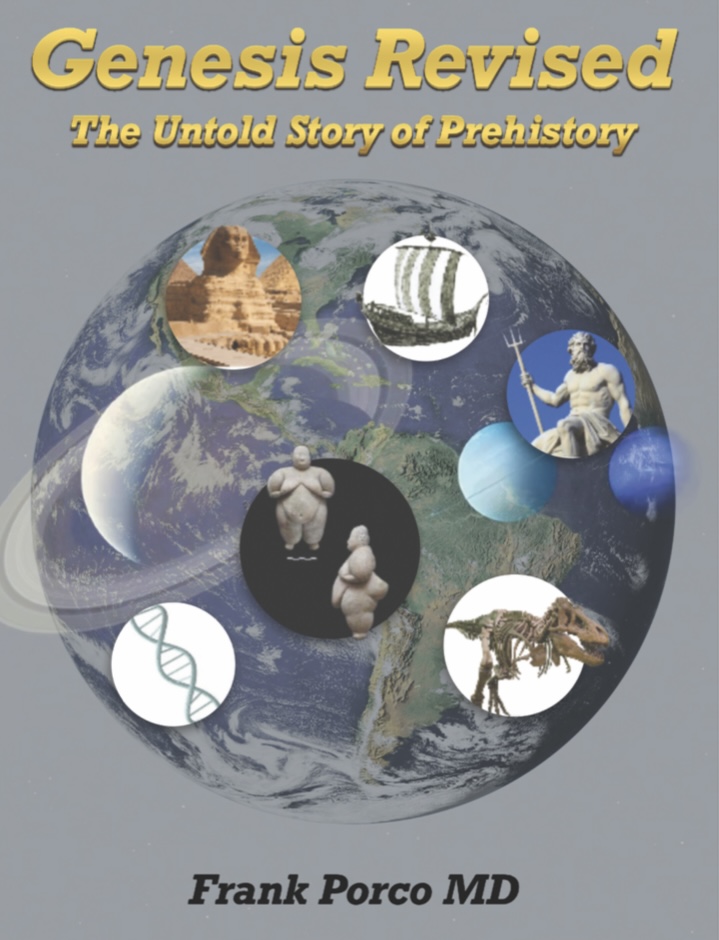
The Book
Between myth and science lies the untold story of prehistory.
The Bible’s opening chapter presents a cosmology framed in divine order and moral authority. In the millennia since, science has transformed our understanding of the Universe, life, and ourselves.
Genesis Revised—The Untold Story of Prehistory offers a modern scientific creation narrative—not as parable, but as principle. It is not a restatement of familiar ideas, but a reexamination of the evidence, advancing new interpretations and a unifying perspective across disciplines.
The reader is taken on a journey of discovery through the full sweep of cosmic and human prehistory—from the Big Bang to the Dawn of Civilization. Along this arc unfold the birth of stars, the formation of Earth, the emergence of life, and the long evolutionary ascent of humankind—including the provocative scenario of a semi-aquatic tropical ape phase in our early development. Humans did not evolve on the dry savanna as a hunter-gatherer, but as fisher-foragers on the ocean shore eating a seafood diet rich in omega-3 fatty acids—the essential building blocks for larger brains.
Across shifting climates and sea level flux, the narrative traces early human migrations, the great Ice Ages, and the archaeological remnants of lost worlds—among them the submerged landscapes of Sundaland and enduring mysteries preserved in myth, including the Garden of Eden and the Island of Atlantis.
This is not a tale of divine fiat, but of unfolding complexity shaped by the forces of Nature and the evolution of mind. Grounded in science yet reaching toward deeper questions, it confronts the central themes of human existence: where we came from, what we became, and where we may be going.
Table of Contents
- Introduction
- 1) Cosmology
- 2) The Evolution of Planet Earth
- 3) Australopithecus—The Upright-Walking Chimp
- 4) The Quaternary Period
- 5) Semi-Aquatic Evolution of Hominids
- 6) Homo erectus
- 7) Homo heidelbergensis (archaic Homo sapiens)
- 8) The Neanderthals (Homo neanderthalensis)
- 9) Homo sapiens (Anatomically Modern Humans)
- 10) The Adam and Eve Story
- 11) The First Modern Human Europeans
- 12) The Rise of Civilization in the Neolithic
- 13) The Civilization Called Egyptian
- 14) The Aegean: Crete and Ancient Greece
- 15) Ancient Persia and the Indus Valley Civilization
- 16) Sundaland—The ‘Lost Subcontinent’
- 17) The Island of Atlantis
- Epilogue
From the book
Excerpts
Introduction
…Humanity stands apart in the known Universe for a singular trait—self-awareness. We are not only alive, we know that we are alive—we are Sentient Beings. This capacity for conscious reflection sets us on a unique path. It allows us to ponder not only our existence, but to also wonder why. With awareness comes uncertainty. When we turn our gaze inward, a cascade of Existential Questions arise, such as:
• Who am I?
• Why am I here?
• Where did I come from?
• Why must I die?
• And what, if anything, lies beyond?
These are not trivial curiosities. They are the essential questions of the human experience—questions born of our unique ability to contemplate our own nature and fate…
Chapter 1
Cosmology
…On the first page of the New King James Version of the Holy Bible, the Book of Genesis famously opens with the words “In the beginning...”. So let us begin—at the very beginning. But in truth, in the beginning, there was no beginning. It is an absurd notion because it presupposes linear time. The Universe, like a circle, has no beginning and no end. What we perceive as beginnings and endings are just phases in one big Cosmic Cycle: Big Bang → Singularity → Big Bang → Singularity—again and again, without end…
…Astrophysicists may have painted themselves into a cosmological corner. With no evidence for gravitons, no physical detection of dark energy, and a mathematical singularity that never described a real state of nature, the Standard Model has grown increasingly speculative—propped up by multiple universes, extra dimensions, and alternate realities. These constructs, detached from empirical verification, arose largely to rescue a model drifting away from physical reality. This raises a fair and necessary question: Is cosmology in crisis?…
Chapter 2
The Evolution of Planet Earth
…But the newly forested land was not the sole domain of plant life; these energy-dense habitats were ripe for exploitation by animal life. In the Silurian, the invertebrate arthropods gave rise to the first terrestrial animals, the insects—multi-legged spineless arthropods having an exoskeleton. They became so well established that by the end of the Devonian, they were the dominant land animal at the apex of the food chain. Some insects evolved wings, becoming the first animals in Earth’s history to fly…
…Africa’s sheer size, equatorial position, and geological diversity have played an outsized role in shaping the evolutionary paths of terrestrial life. Tens of millions of years ago, the continent’s evolutionary trajectory was set in motion as the African and Arabian plates began drifting northward. Around 25 million years ago, this tectonic movement initiated a slow collision with the EurAsian plate, gradually closing the remnants of the ancient Tethys Ocean. The result was the formation of the East African Rift Valley—a colossal geological scar that would cleave the eastern flank of Africa over the next several million years. As throughout Earth’s history, the interplay of plate tectonics and climate reshaped regional ecosystems, setting the stage for evolutionary innovation. In this case, it would prove pivotal: the Rift Valley became the “Cradle of Humanity,” from which the human clade would ultimately emerge...
Chapter 3
Australopithecus
…Australopithecus (meaning ‘southern ape’) was a chimpanzee in stature and brain, yet walked upright like a human. It was the first semi-aquatic bipedal primate—an evolutionary outcome not of arid savannas but of the fluvial and lacustrine littoral of the East African Rift Valley. Wading upright in shallow water—their bodies supported by the relative weightlessness of buoyancy—they had access to abundant littoral food and freshwater, conferring on these early hominids a clear survival advantage. Over thousands of generations, better waders were naturally selected, as bipedalism was gradually written into their anatomy...
Chapter 4
The Quaternary Period
…The Quaternary Megafauna Extinctions
Earth’s climate entered a phase of sea-sawing instability—abruptly alternating pulses of warmth and cold, wet and dry, retreating and advancing glaciers, and sea level fall and rise—all occurring in what amounts to a geological heartbeat. Vegetation zones shifted and ecosystems unraveled. Across the globe, large mammals—woolly mammoths, mastodons, giant ground sloths, saber-toothed cats—that had thrived for hundreds of thousands of years could not adapt quickly enough and vanished—victims of extreme climate oscillation…
Chapter 5
Semi-Aquatic Evolution of Hominids
…During the Second Aquatic Phase, a period of pluvial flooding, a clade of semi-aquatic bipedal hominids expanded eastward out of the East African Rift Valley. They traveled downstream along the banks of rivers until they arrived at the river deltas on the Indian Ocean littoral, an ideal habitat to live a beachcombing lifestyle, where tropical jungle met the ocean. The river delta represented a novel and unique niche to these hominids that provided a reliable source of food and freshwater, and would prove to become the preferred habitat of future settled communities, as river deltas still are till this day. It was on the warm Indian Ocean littoral, not the arid savanna, that a bipedal hominid took a step toward human speciation as Homo habilis (Australopithecus aquaticus) made its first appearance in the fossil record around 2.5 MYA. It is also during the Second Aquatic Phase that deliberately modified stone tools—Oldowan lithics—first appear in the archaeological record around 2.6 MYA…
Chapter 6
Homo erectus
…Fire Control: The Game-Changer
After hundreds of thousands of years of knapping, a Homo erectus hominid stumbled upon the secret of fire control around 1.8 MYA. By striking together the right stones, sparks flew. Maybe this hominid was intrigued, maybe he or she showed off this newfound skill to hominid children who laughed with delight. But eventually a spark landed on tinder and the first manmade fire flared to life. Fire-starting was not just a new technology—it was revolutionary. With a fundamental force of Nature now under their control, hominids could alter the conditions of their environment rather than be directed by it. This not only changed the course of their evolution, it changed everything!…
Chapter 7
Homo heidelbergensis
…As with Australopithecus and Homo erectus, the classification of Homo heidelbergensis has been the subject of heated debate. But nowhere is the frustration of paleoanthropologists more evident than here. The tendency in the field has long been to name a new species at the first sign of morphological difference. In reality, Homo heidelbergensis was a highly adaptable species—shaped by extreme climatic variability and occasional interbreeding. Their anatomy reflects a transitional mosaic: bridging Homo erectus with the cold-adapted Neanderthals of Europe on one path, and with modern Homo sapiens in tropical Africa on another...
Chapter 8
The Neanderthals
…By 250,000 YA, during the Mindel-Riss interglacial, Neanderthals had developed their distinctive suite of physical traits—the ‘classic’ Neanderthal—a cold-adapted big-game hunter. Clearly they were not modern humans. Stocky, heavily muscled, and powerfully built, Neanderthals had the most robust skeletons of any hominid. Skeletal muscle attachment sites on bones were very prominent, reflecting the muscle stress of intense physical activity. Their compact body proportions helped conserve heat by reducing their total body surface area—a clear adaptation to glacial climates. Evidence of multiple healed fractures in their bones is testament to the rigors of their lives, fighting both beast and cold…
Chapter 9
Homo sapiens
…hominid evolution proceeded in pulses of encephalization associated with five Aquatic Phases, each corresponding to Rift Valley pluvial periods. In the First Aquatic Phase, a semi-aquatic, upright walking chimpanzee, Australopithecus, appeared in the fossil record around 4.4 MYA. In the Second Aquatic Phase, a clade of australopithecines expanded to river deltas along the Indian Ocean littoral, adopting a fisher-forager lifestyle. Australopithecus aquaticus, essentially a bipedal, upright walking chimpanzee with a larger brain, first appearance in the fossil record around 2.5 MYA. It was during this time that intentionally modified stone tools also made their first appearance, inaugurating the Stone Age. This was a watershed moment in evolutionary history because it marked the dawn of the intellectual evolution of memes, a singularly unique human triumph. From this point forward, instead of passively adapting to their environment, these hominids began the long road of creating technologies that mold the environment to their needs…
…Meanwhile, on the ocean littoral of East Africa, the core ancestral population of Homo heidelbergensis continued the fisher-forager way of life. During the Fifth Aquatic Phase, a clade underwent speciation around 200,000 YA into Homo sapiens (meaning ‘wise men’). These Anatomically Modern Humans were semi-aquatic tropical apes—large-brained, dexterous, and behaviorally modern. They had the same anatomy and intelligence as people living today. These early moderns developed increasingly complex social networks, culture, and technology. The ‘Beachcombing People’ took the path of least resistance, following the Southern Coastal Route during the Third ‘Out of Africa’ migrations—not only across the Old World, but eventually into the New World as well…
Chapter 10
The Adam and Eve Story
…An Extraordinary Encounter
When Anatomically Modern Humans reached the Levant, they experienced an extraordinary encounter—one that would leave a permanent mark on the human genome. For the first time, there was both a regional and temporal overlap between the Neanderthals and their first cousins, modern humans. The nature of their interactions remains speculative. They may have been curious yet cautious of strangers; territorialism might have led to conflict and the taking of female prisoners, or perhaps there was tentative barter of goods—and eventually females—between bands. It is even possible that the meeting was entirely peaceful and they intermingled freely. Whatever the social dynamic, the genetic outcome is clear: interbreeding occurred between these two Homo lineages, and it happened in the Levant…
…Around 85,000 YA, bands of the Persian Gulf Oasis people were forced to leave their Eden paradise in search of new niches to exploit. They took the path of least resistance along the Southeastern Coastal Route—hugging shorelines, living off the sea. This beachcomber’s highway led them around the Indian subcontinent, and through the now-submerged lands of Sundaland. Here, the road split. Some took the East Fork, island-hopping by boat to Oceania—Sahulland (Australia, New Guinea, and Tasmania), Micronesia, and Melanesia. Others followed the North Fork along the beaches of the Pacific Rim past China, Korea, and Japan, eventually reaching Siberia and crossing the Beringia land bridge into the Americas…
Chapter 11
The First Modern Human Europeans
…Childbirth is arguably the most memorable and dangerous event in an adult woman’s life, starting with a gestation lasting ten full moons, and culminating with the bursting of waters and the onset of labor. Through excruciating pain and blood a new life is brought into the world. But not uncommonly, childbirth resulted in the death of the child and/or the mother. It is no small wonder that women across ages and cultures fervently worshipped her. Over time, the Mother Goddess acquired new images and roles. To her Paleolithic image was added a Mesolithic role of Goddess of Grain and Agriculture. By Neolithic times she was also the Mother of the Gods, and Queen of Heaven and Earth. Towards the Bronze Age her influence waned and she increasingly became usurped by the male sky gods of expanding nation states and empires; the focus of her manifestations shifted to revolve around death as she became the Goddess of War…
…Reference will be made to the Mesolithic Gap—herein defined as a roughly 9,000-year worldwide gap in our knowledge about the end-Pleistocene to early Holocene transition. This span, sandwiched between the end of the Last Glacial Maximum (c. 17,000 YA) and the 8.2 Kiloyear Event, remains one of the most obscure intervals in prehistory, largely because of the 500-foot rise in global sea level that drowned coastal settlements and reshaped the face of the Earth. It was from this submerged world that the seeds of modern civilization originated…
…Agriculture was a modification of the environment by humans to fit their needs; thus agriculture is totally artificial. Why would anyone voluntarily opt for a harder way of life especially when food was abundant? Why would the majority work harder to feed a minority of non-farmer members of the community who worked less? It doesn’t make sense. The real question, then, is not how agriculture began, but what was the impetus to compel modern humans to radically restructure human society and adopt labor intensive and precarious agriculture with all its unintended consequences? And why did it start after 11,500 YA?…
…Never having built a city before, the people of Catal Hoyuk were on a steep learning curve. The settlement consists of a cluster of hundreds of rectangular mud-brick dwellings in a honeycomb-like maze without streets or alleyways. Lacking doorways, ladders were used to access the dwellings through trapdoors in the roofs. The roofs in essence, were the streets. To move around the maze of the settlement, one had to climb or descend a series of ladders across the multitiered roofs. The outermost walls of the doorless dwellings acted as a perimeter wall to the settlement. With no main entrance, the place would have had a closed and uninviting fortress-like feel to outsiders. To the residents, the atmosphere may have felt confined—a prison-like fortress of their own making…
Chapter 12
The Rise of Civilization in the Neolithic
…But this ‘birthright’ is solidly contradicted by the archeological evidence. The birth of civilization at Sumer is an illusion, producing a false archeological horizon. Recent discoveries, like Gobekli Tepi, Catal Hoyuk, the lost Danube Civilization of Old Europe, and Ebla were all products of a civilization-producing cultural matrix, and serve to prove that what we consider to be civilization predates Sumer by many thousands of years…
…The deciphering of Sumerian cuneiform allowed a past culture for the very first time to ‘speak’ to us—and what they had to say is quite shocking! The ruling elite priesthood told their peasant masses that humanity was created by the gods as a slave race, to serve and labor to fulfill the will of the gods. Of course, the ‘gods’ were not supernatural beings, but the ruling priesthood themselves, cloaking their authority in myth. All the delights and privileges of the physical world belonged only to the elites; as for the peasant masses, existence meant obedience and toil—their knees were as calloused as their hands…
…The major spoil of war is not gold or natural resources per se, but the conquest and subjugation of other people. True king power emanates from the number of people under domination. Western civilization was not the story of progress; at its root, civilization is nothing more than the habituation to subjugation…
Chapter 13
The Civilization Called Egyptian
…The Osireion’s construction not only differs from Seti’s temple, it's completely different from all classical Egyptian architecture. It evokes a technological and symbolic tradition far removed from the Bronze Age. In remote antiquity, the Osireion might very well have stood on the western edge of the Nile as an open-air sanctuary with a ritual well and arch-roofed ambulatory. Over many millennia, the structure was buried and forgotten under shifting sand as the course of the Nile changed. Since the Osireion and Temple of Seti I appear to be of drastically different ages, is there another site in Egypt that mirrors the construction style of the Osireion? Well there just so happens to be another sacred site 300 miles to the north—on the Giza Plateau…
…One of the principal Egyptian creation myths—distinct from the Zep Tepi tradition of the Edfu Building Texts—derives from the Pyramid Texts of the Old Kingdom. In this account, creation began before the dawn of time, when the primordial god Atum emerged amid swirling chaos and spoke the world into existence. Atum used heka, a magical primal force, to transform chaos into ma’at, cosmic order and harmony. The sun god Ra then rose from the chaos for the first time…
Chapter 14
The Aegean: Crete and Ancient Greece
…Ancient Greece is often hailed as the ‘Cradle of Western Civilization’. Yet contrary to popular belief, the Greeks arrived late to the civilization party. The zenith of Greek Culture—the Classical Period—spanned only two centuries, from roughly 550 to 350 BCE. Considering all the cultural happenings in SouthEast Asia, Anatolia, and across the Fertile Crescent during the Mesolithic, it is rather strange that there was a void of human activity in the Southern Balkans…
…The gross inequality of the Mycenaean Age is evident in the stark contrast between the opulence of the palace and the austerity of the peasant village. One could argue that, beginning in the northern Levant homeland of the Late Natufians, the Cult of Cultivators laid the foundations of the Old World Order—an unbroken chain of autocratic religious-political structure that imposed a rigid caste system and fostered the rise of urbanized civilization, all predicated on coerced labor. This structure persisted for millennia—until it was briefly challenged by the arrival of the new and disruptive technology of iron. For the first time, the common people possessed the means to resist oppression en mass…
…To the Ancient Greeks, Pandora was the first woman on Earth—counterpart to the Biblical Eve. Both women disobeyed their gods: Pandora opened the forbidden box and unleashed evil into the world; Eve accepted the serpent’s gift of gnosis (knowledge) and brought mortality and the original sin of disobedience upon all humanity. In both myths, paradise was lost through the impulsive curiosity of women—a reflection of the patriarchal lens through which Greek and Biblical writers sought to explain the origin of evil in the world…
Chapter 15
Ancient Persia and the Indus Valley Civilization
…Archaeological evidence indicates that the people of the Indus Civilization did not display a stark divide between rich and poor, either in life or death—not many burials could be described as elite. They appear to have been primarily farmers, herders, artisans, and merchants, without evidence of the rigid social stratification (caste system) that was soon to come in Vedic times…
…The Aryan Invasion Theory had its origins innocently enough in the 19th Century when linguists noticed that the Sanskrit language of the Indian subcontinent shared cognates, grammar, and vocabulary with many European languages—particularly Ancient Greek and Latin. When these related languages were mapped, a conspicuous gap appeared between India and Europe, filled by unrelated Near Eastern languages. Scholars proposed an ‘Indo-European’ language macro-family that must have descended from a common ‘mother tongue’, termed Proto-Indo-European (PIE)—that diffused out of some yet-unknown homeland. The search for the Indo-European homeland had begun…
Chapter 16
Sundaland
…Antediluvian Sundaland
During the last glacial period, the Sunda Shelf was progressively exposed as global sea levels fell while continental glaciers expanded in both hemispheres. Because the shelf is broad and gently sloped, even modest drops in sea level exposed vast swaths of seabed early in the glaciation. As the South China Sea, the Gulf of Thailand, and the Java Sea went dry, Island SouthEast Asia became physically joined to the Asian mainland, forming Sundaland—a subcontinent estimated to have been twice the size of India. Owing to its equatorial position, Sundaland enjoyed a tropical and humid climate throughout all of the Ice Age…
…The world’s flood myths—describing cataclysmic inundation, forced dispersal, and the rebuilding of civilization—are echoes of this real prehistorical event. Ancient stories like the Seven Sages, remembered as ‘gods’ or ‘culture-bringers’, reflect memories of Sunda survivors: the astronomer priest elites who preserved knowledge of the ‘old ways’. They arrived by sea from a faraway homeland in the East, bringing with them new skills to rebuild civilization—maritime expertise, hierarchal socio-political structure, naked-eye astronomy, navigation, mathematics, megalithic construction, and a rich corpus of legends and mythology…
Chapter 17
The Island of Atlantis
…Yet there is reason to reopen the case against Plato and reconsider his tale to be a historical fiction about an event of monumental proportions—the faded memory of which was already thousands of years old when Plato wrote about it. New paleo-climatic, archaeological, and paleo-genetic evidence—information only available to researchers in the last few decades—supports the existence of a Mesolithic maritime kingdom precisely when and where Plato said it would be. Having no concept of what such a kingdom might look like, Atlantis was imagined by Plato to be a preeminent Bronze Age kingdom of pre-Classical Greece, worthy of the gods, and complete with agriculture, pottery, metal working, and trireme ships—an idealized vision shaped by his own era…
…In essence, the story of Atlantis was really about a great war in the Mediterranean that took place in very ancient times. According to the Egyptian high priests, Solon’s pre-Greek ancestors—the Pelasgians—were allied with Egypt against the powerful island kingdom of Atlantis. This Greco-Atlantean War ended when a catastrophic flood and earthquake destroyed the Island of Atlantis, and the Aegean homeland of the Greeks. Riverine Egypt was spared, allowing the memory of this monumental event to be preserved in Egyptian archives. The priests of Sais dated the destruction of Atlantis to 9,000 years prior to Solon’s visit to Egypt—yielding a date of around 11,600 YA...
The Author
Purchase
Get your copy on Amazon today
and start your journey of discovery!
Paperback or eBook
(650 pages)
200 Maps and Images

Revision Pressworks
Fort Lauderdale, FL
For more information
For press inquiries, bookseller orders, advance copies, rights, or general questions about the book, write to:
Gallery
Selected Color Images
Note: To bypass Amazon KDP’s 600-page limit for color printing and keep production costs low, the Paperback edition was produced in black and white. Because some images did not format as intended, these high-resolution color images from the book are provided to ensure no details are missed:
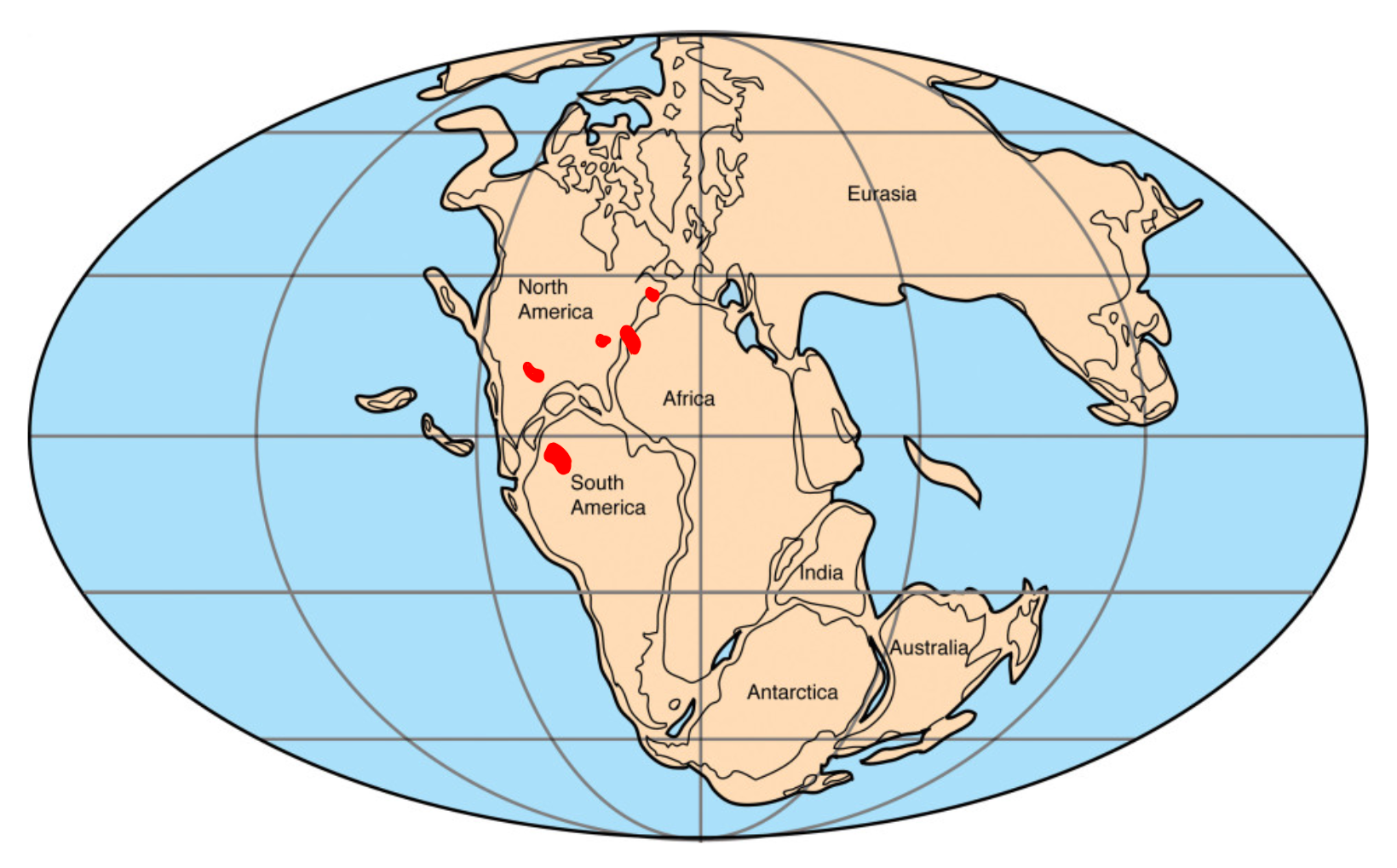
Figure 2.9 Last of the supercontinents, Pangaea 335 MYA, formed from the collision of Gondwana with EurAmerica. Red regions indicate remnant flood basalt dikes (see CAMP discussion). (Figure Credit 2.9: USGS, Public Domain)
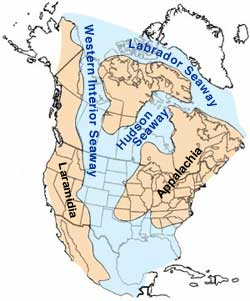
Figure 2.11 Western Interior Seaway over North America during the mid- Cretaceous transgression, c.100 MYA, when over 80% of Earth’s surface was covered by water. (Figure Credit 2.11: USGS, Public Domain)
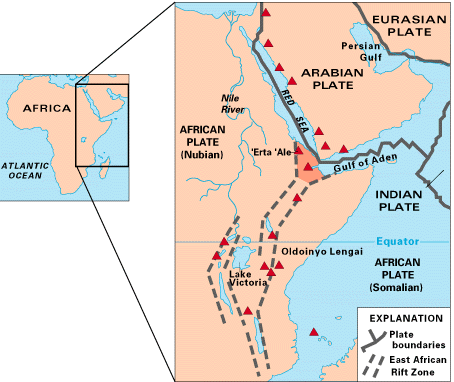
Figure 2.17 Map of East Africa and the Afar Triangle or triple junction (shaded at the center), where three plates—the Arabian Plate and the Nubian and Somali parts of the African Plate—pulled apart forming the East African Rift Zone. It was the environment of this zone that drove the evolution of the primate family. (Volcanoes are depicted as red triangles.) Figure Credit 2.17: USGS, Public Domain)
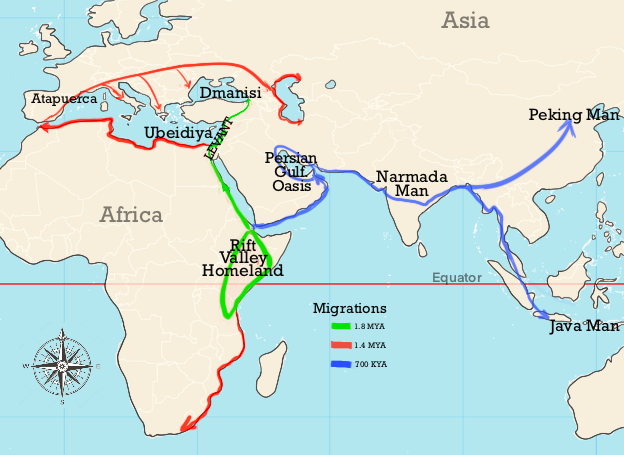
Figure 6.2 The First ‘Out of Africa’ Migrations by Homo erectus. See text for timeline. (Figure Credit 6.2: Drawing by Author)
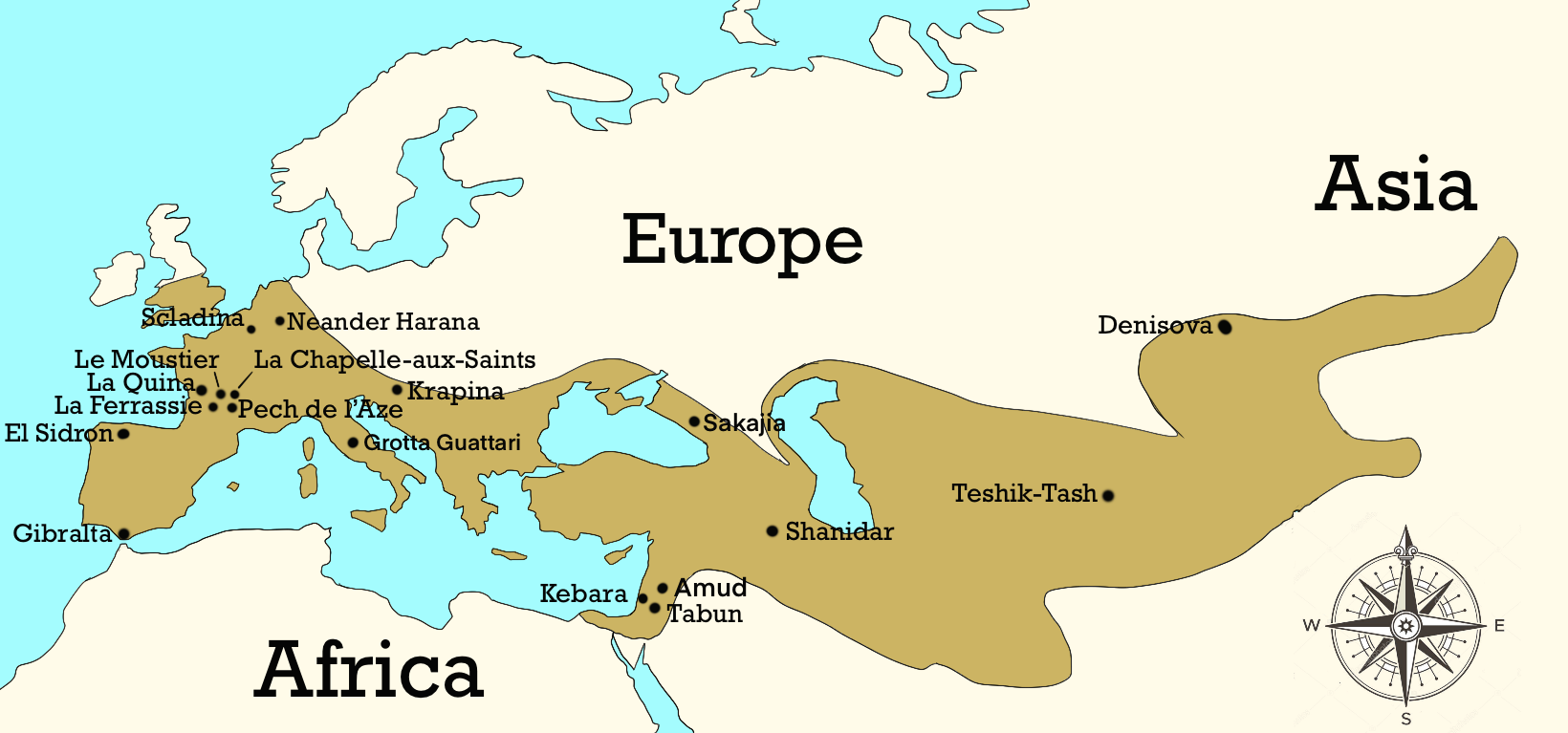
Figure 8.2 Neanderthal range across Europe and Asia, with select archaeological sites. (Figure Credit 8.2: Adapted from Neanderthalgo under CC-BY-SA 4.0)
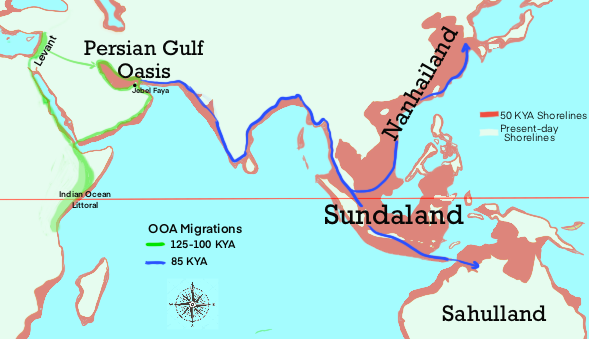
Figure 10.1 The Third ‘Out of Africa’ Migrations by Anatomically Modern Humans occurred in two distinct phases: 125,000 YA and 85,000 YA. (Figure Credit 10.1: Drawing by Author)
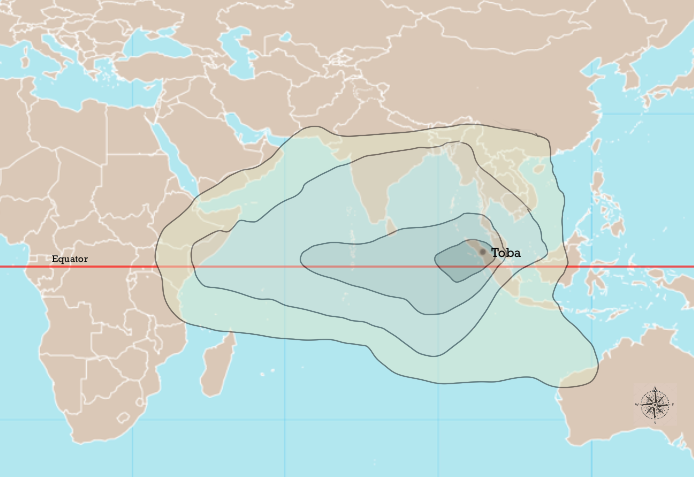
Figure 10.2 Distribution of the toxic Mount Toba Supervolcano ash cloud to the northwest engulfing the Indian subcontinent. Note: sea levels were lower than depicted. (Figure Credit 10.2: Drawing by Author; Adapted from researchgate.net/ publication/264934259: Costa A, et al: The Magnitude and Impact of the Youngest Toba Tuff Super-eruption; August 2014.)
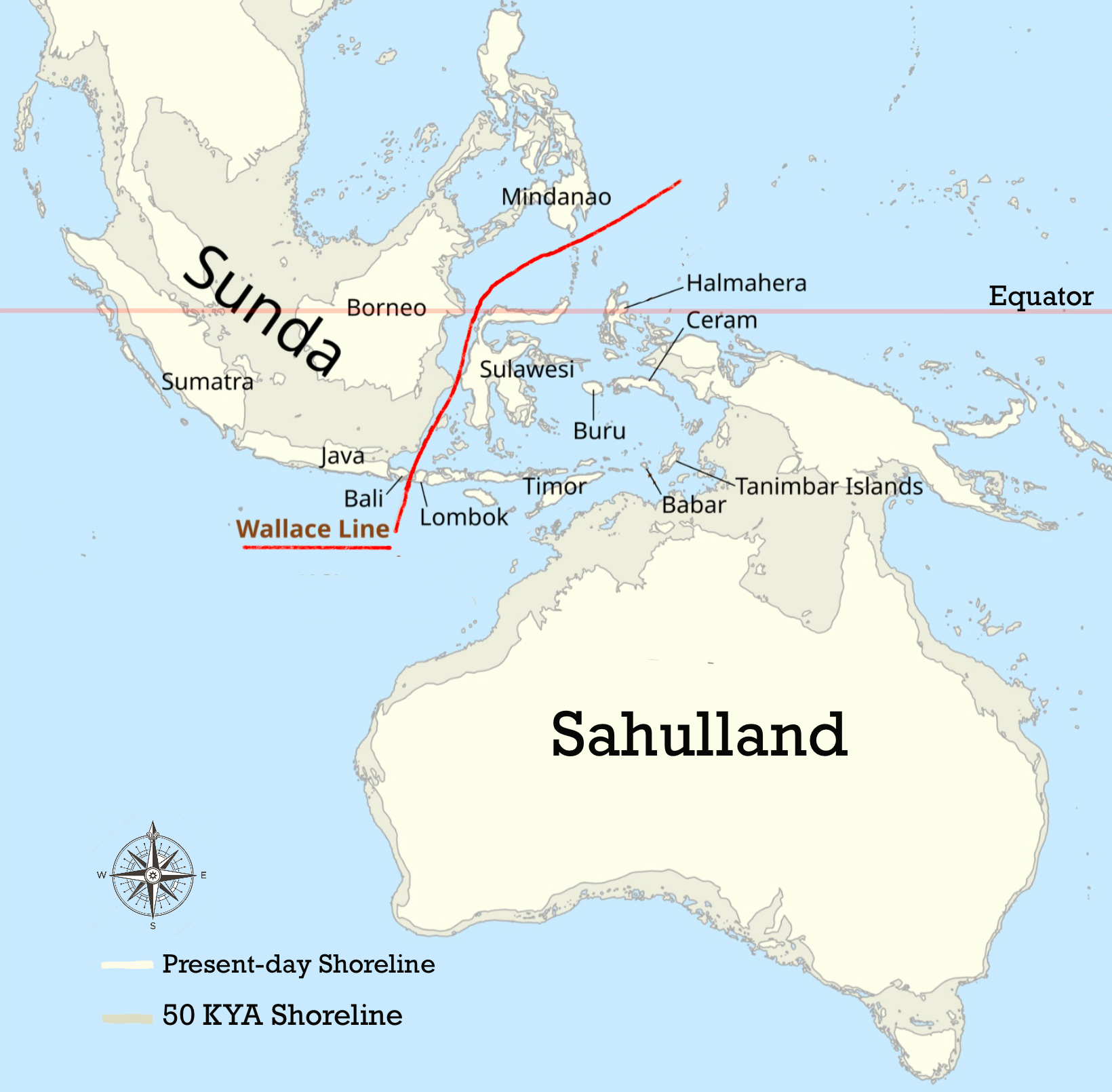
Figure 10.3 Map of SouthEast Asia c. 50,000 YA showing the fused landmasses of Sundaland and Sahulland due to sea level drop of approximately 400 feet. (Figure Credit 10.3: Adapted from listfiles/Kanguole under CC-BY-SA 4.0)
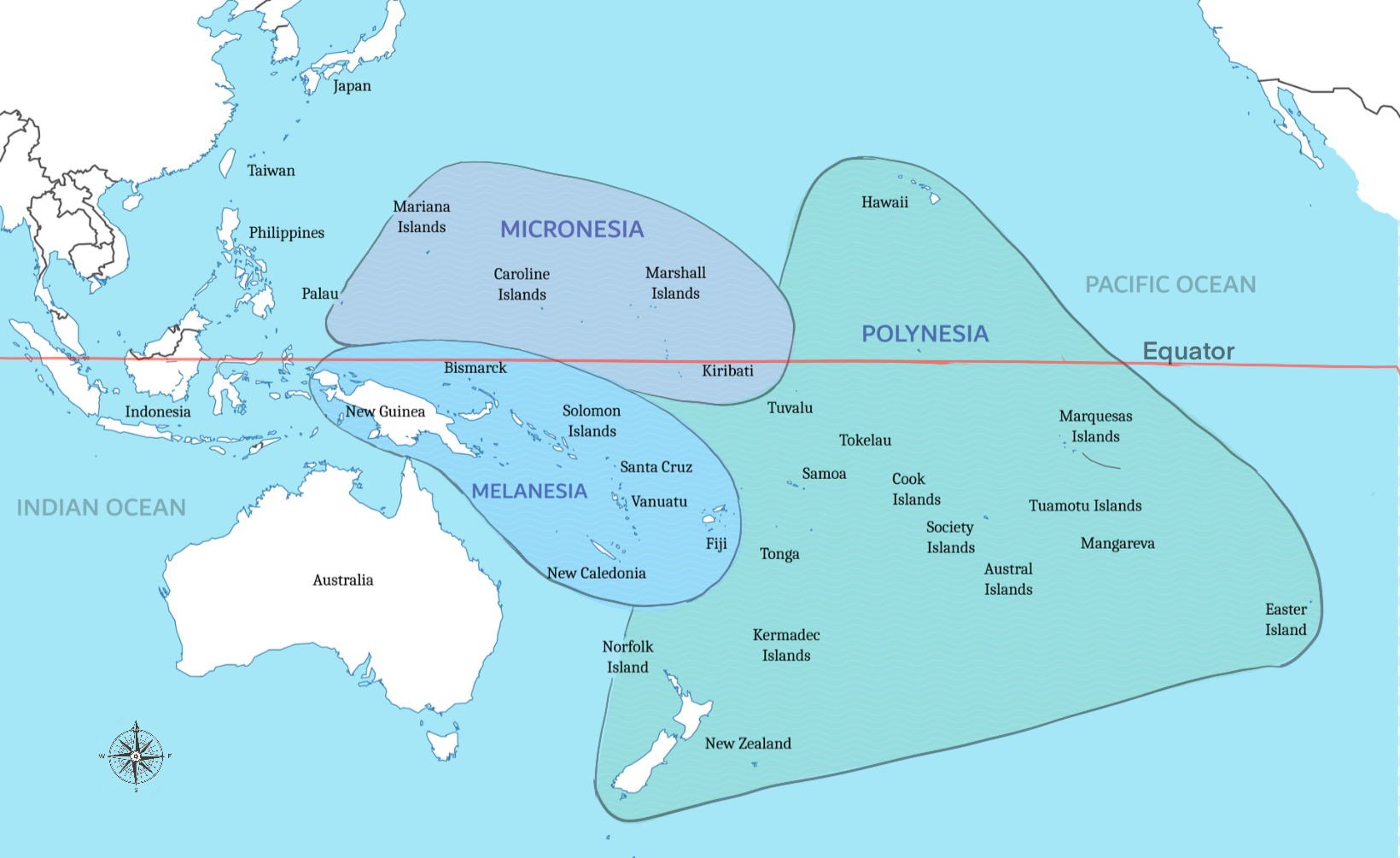
Figure 10.4 Map of Oceania (present-day sea levels) depicting Australia, Melanesia, Micronesia, and the Polynesian Triangle, comprising the East Fork of the Beachcombing Route that required advanced nautical skills. (Figure Credit 10.4: Adapted from Edmund1234 under CC-BY-SA 4.0)
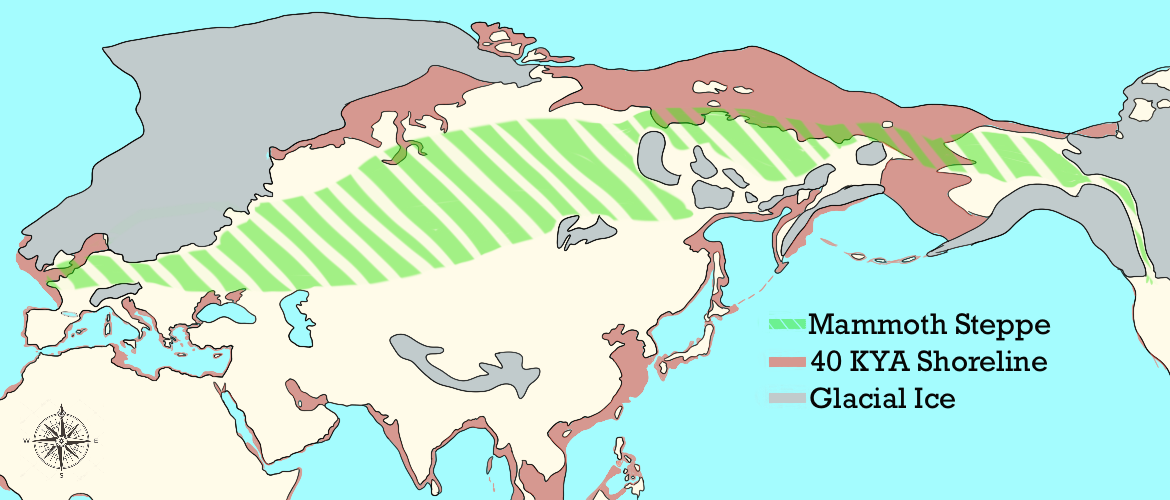
Figure 10.5 The Mammoth Steppe of Eurasia at its greatest extent c. 40,000 YA spanned three continents from east to west. With the deterioration of climate in the lead-up to the Last Glacial Maximum, the Steppe—and the great megafauna herds who depended upon it—went into sharp decline. For the human hunters who depended upon the megafauna herds, the cold kept them confined to its southernmost fringe. (Figure Credit 10.5: Drawing by Author)
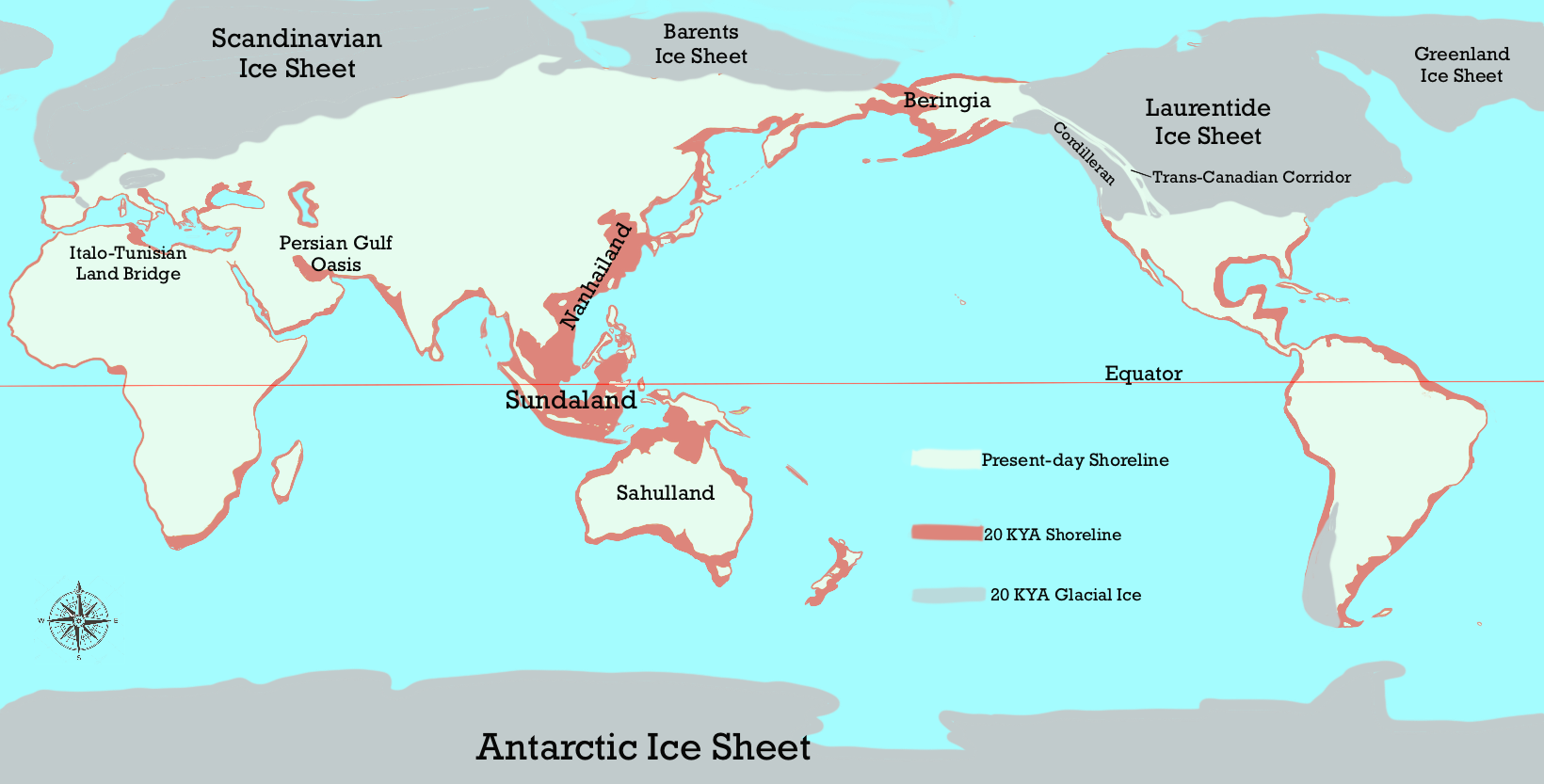
Figure 10.6 This is an important World Map during the Last Glacial Maximum c. 20,000 YA when sea levels were up to 500 feet lower than today. Continental shelf and land bridges were exposed (depicted in red). Note: the trans-Canadian Corridor was closed c. 22.000 YA. (Figure Credit 10.6: Drawing by Author)
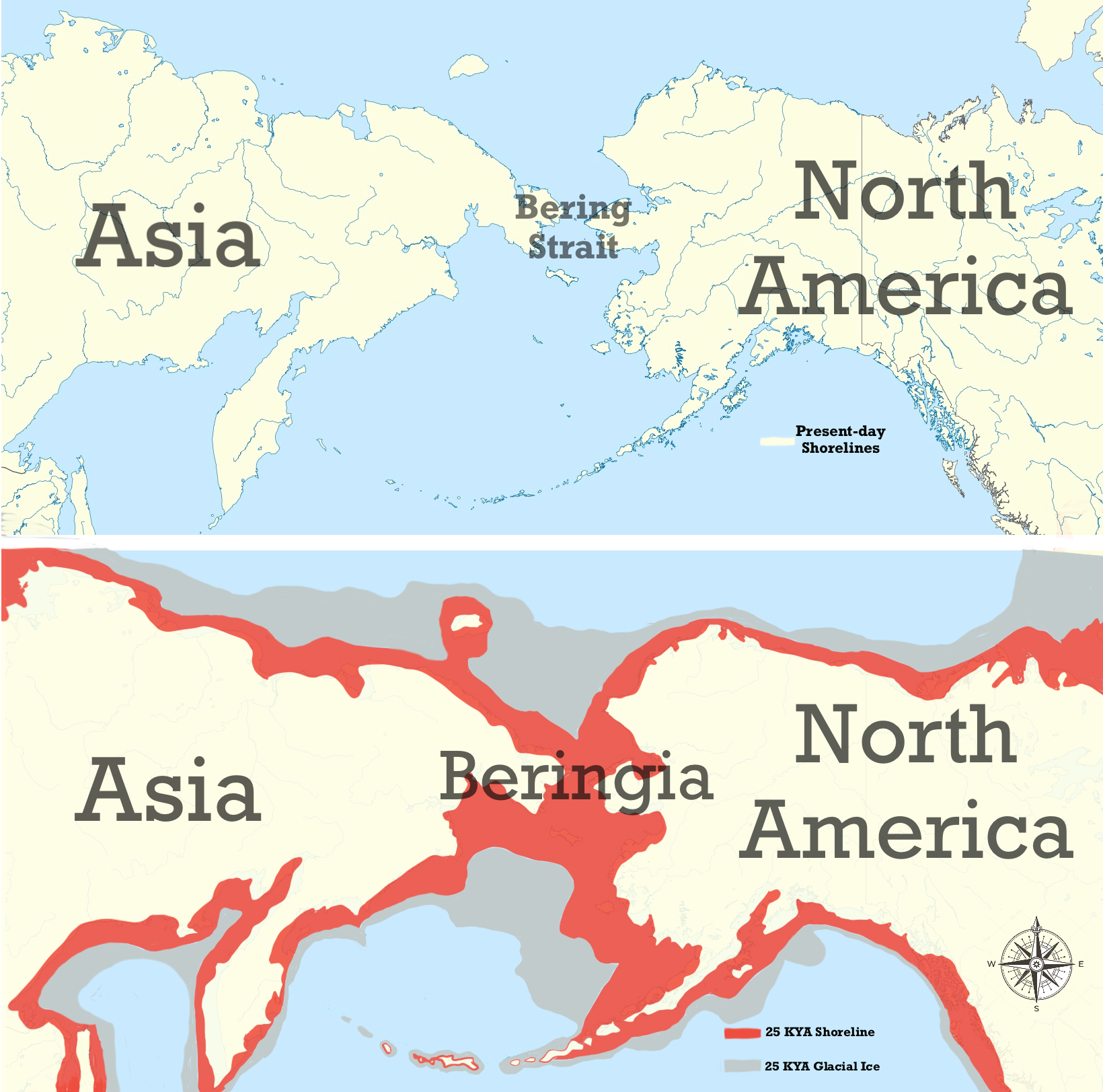
Figure 10.8 Above: Map of present-day Bering Strait separating Asia and North America. Below: Map of Beringia land bridge c. 25,000 YA. (Figure Credit 10.8: Drawing by Author)
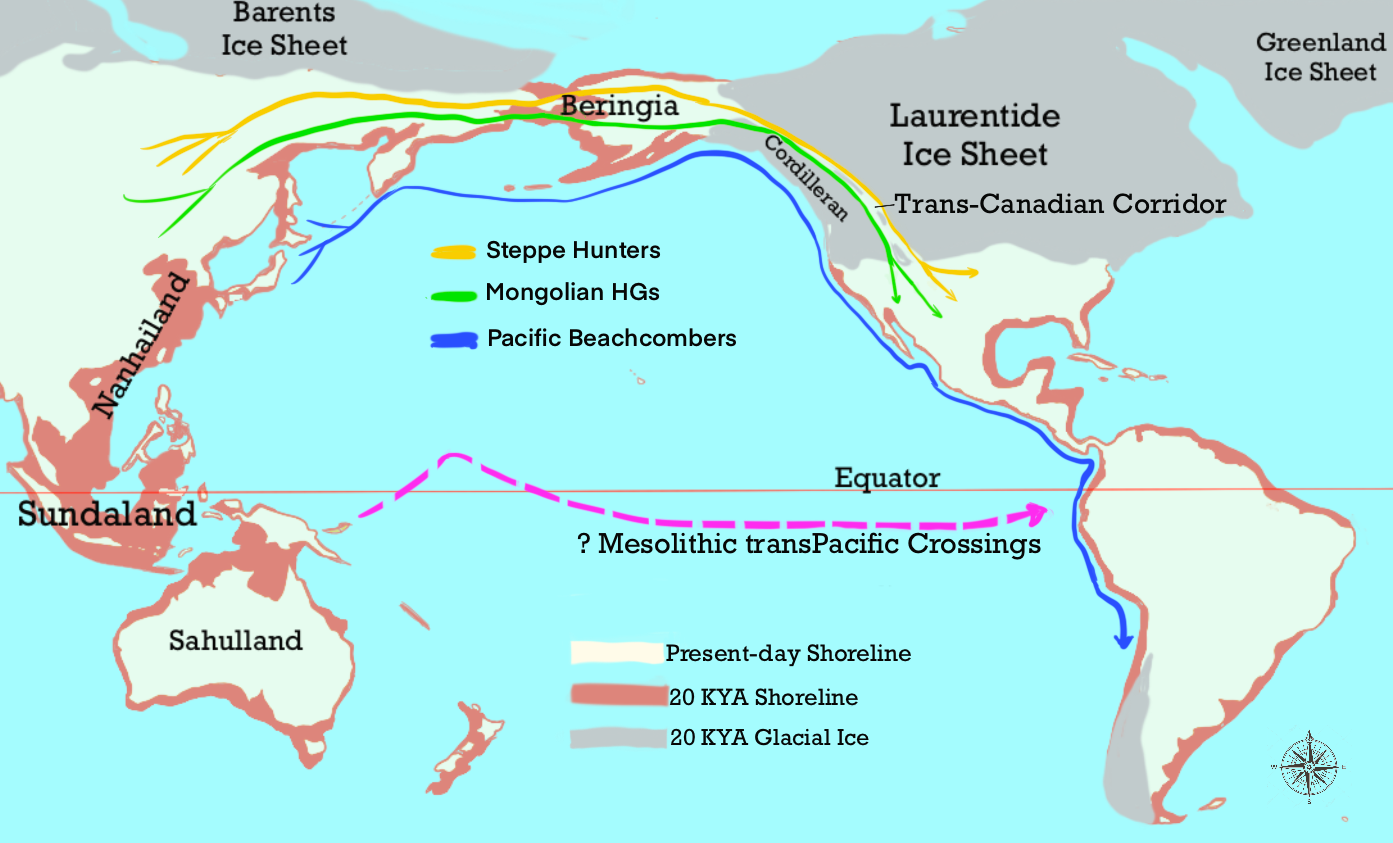
Figure 10.10 Peopling of the Americas by three distinct Asian founder lineages before the Last Glacial Maximum (see text). Megalithic evidence bolsters the possibility of Mesolithic transPacific crossings (see Chapter 16: Sundaland). (Figure Credit 10.10: Drawing by Author)
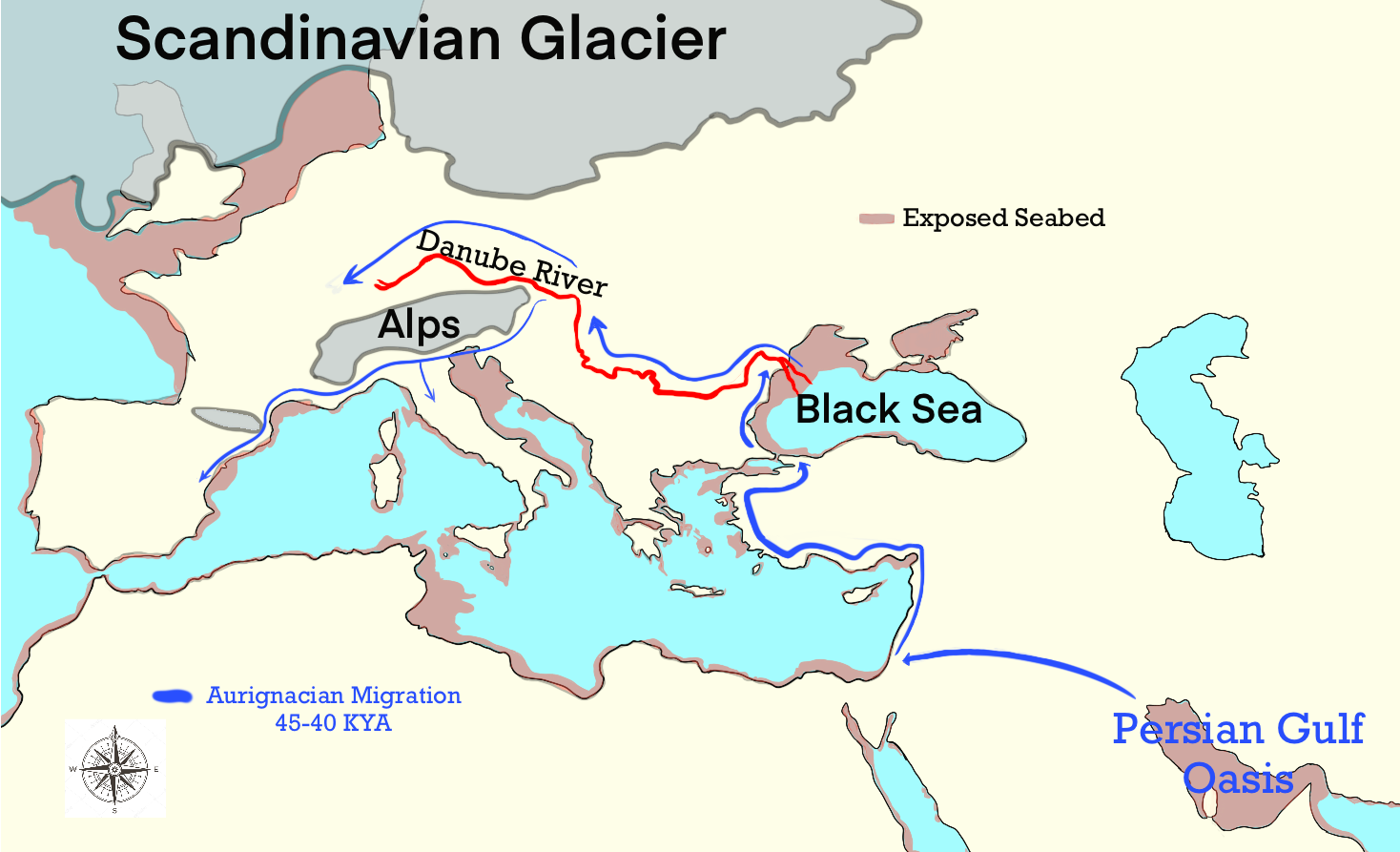
Figure 11.1 The 1st Wave of Anatomically Modern Humans into Europe followed the Danube River superhighway (in red). (Figure Credit 11.1: Drawing by Author)
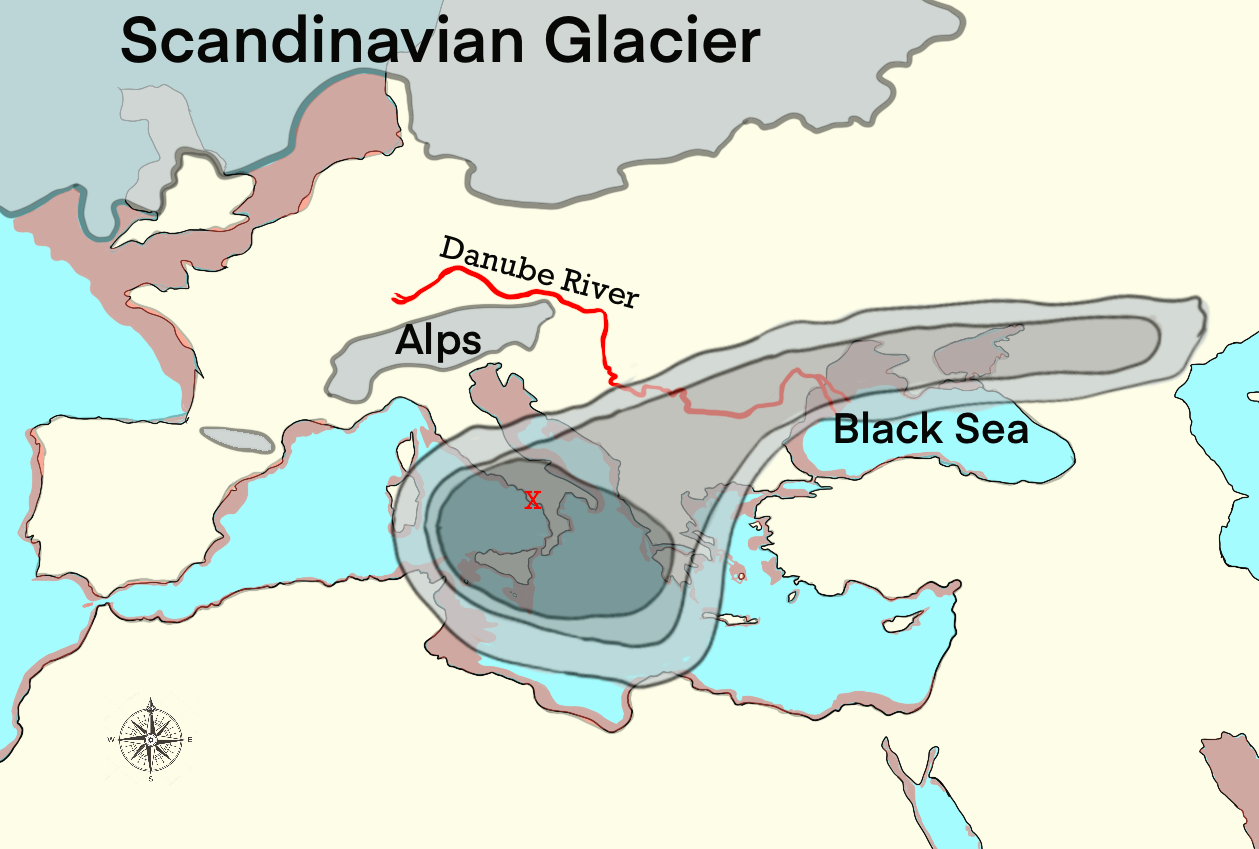
Figure 11.2 Campania super-eruption ashfall kill zone, 39,000 YA. (Figure Credit 11.2: Drawing by Author)
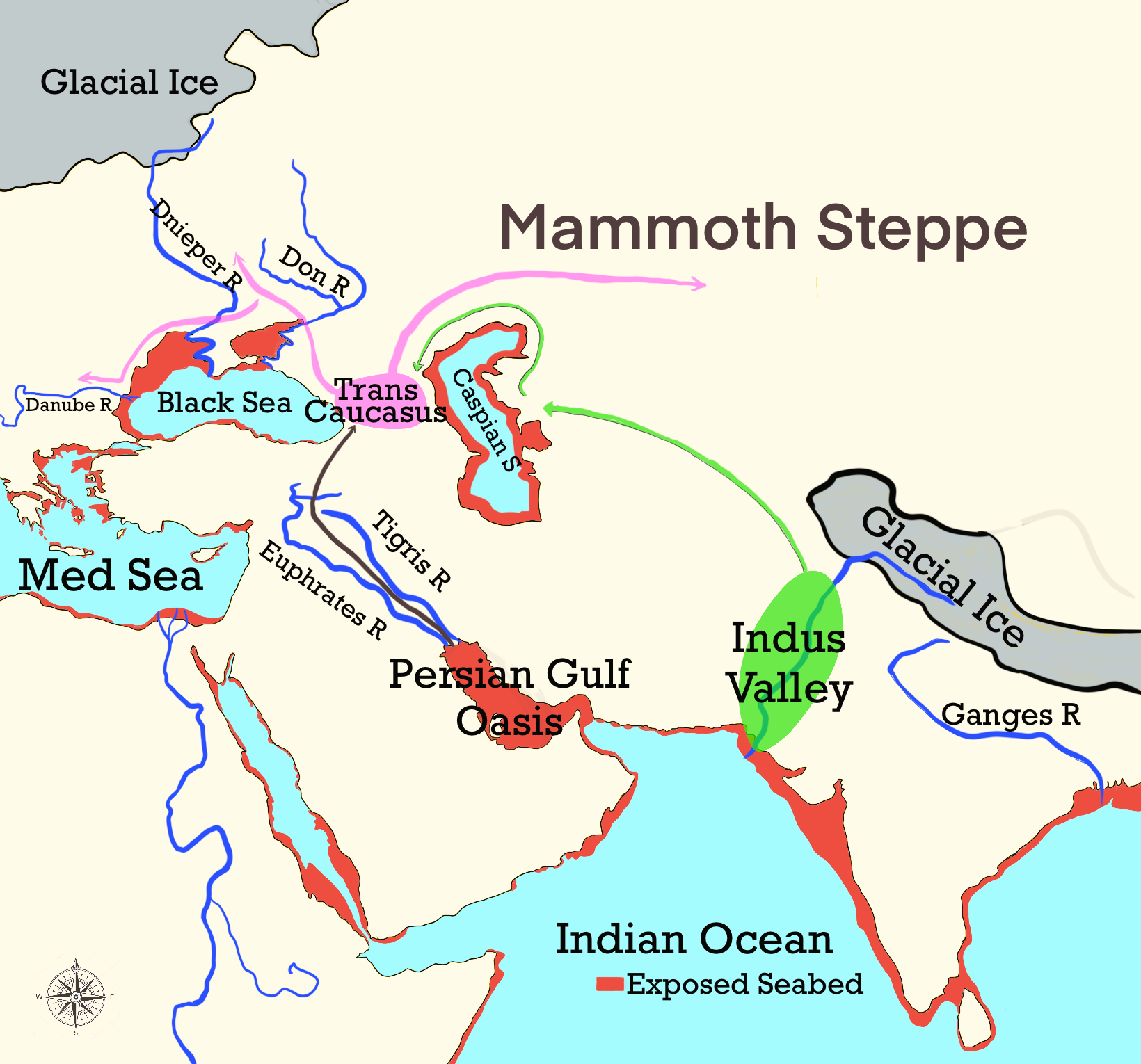
Figure 11.4 Modern humans from the Persian Gulf Oasis and the Indus River Valley converged in the TransCaucasus giving rise to the Gravettian Culture. (Figure Credit 11.4: Drawing by Author)
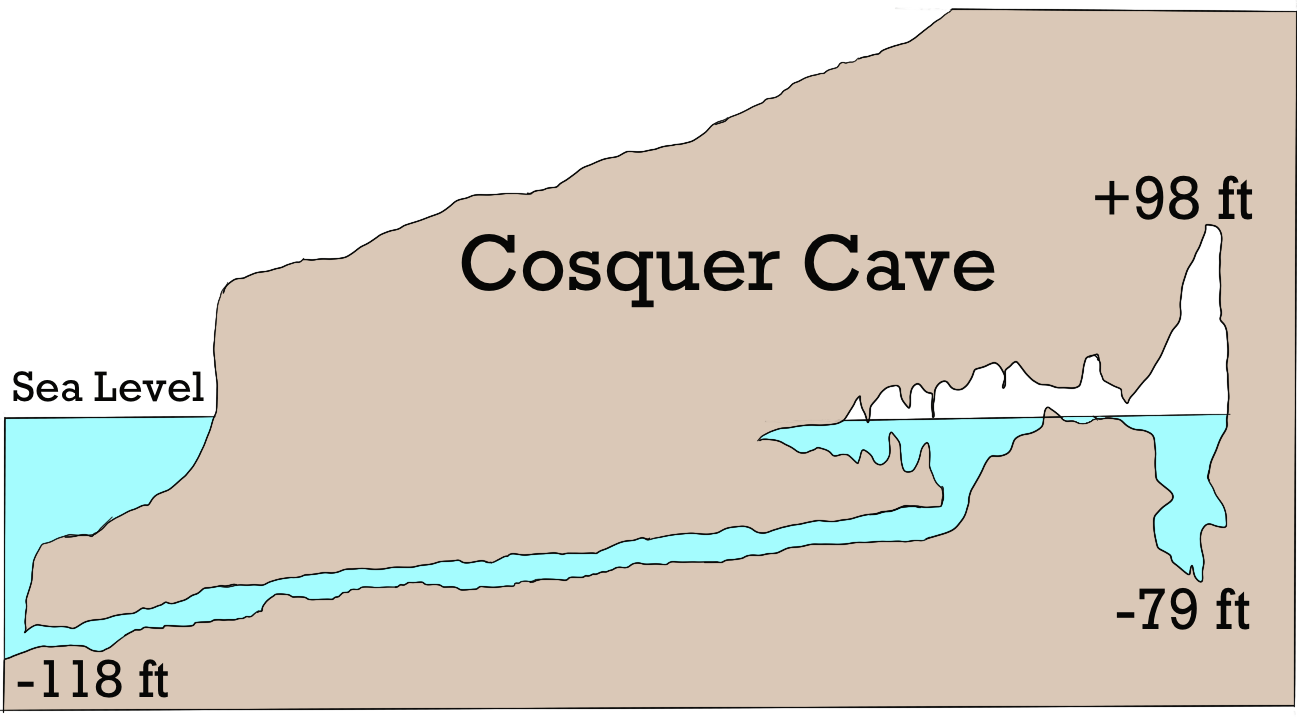
Figure 11.8 Cross-section diagram of Cosquer Cave, the entrance of which was above sea level in prehistoric times. (Figure Credit 11.8: Adapted from Jespa under CC-BY-SA 3.0 Unported)
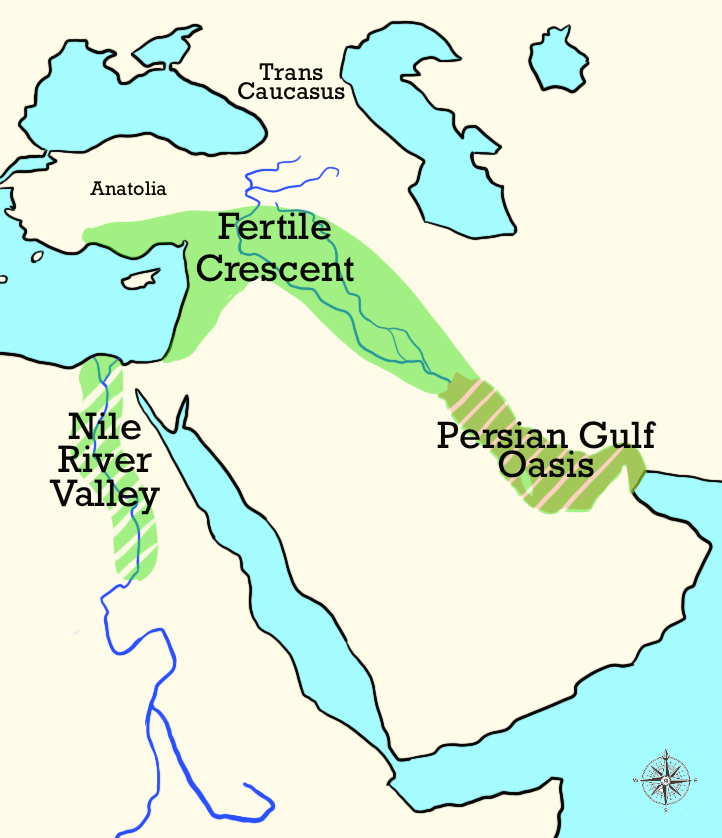
Figure 11.17 The Fertile Crescent region in green (c. 9,500 YA), showing major settlement sites. At that time, Mesopotamia proper had not yet been settled. (Figure Credit 11.17: Drawing by Author)
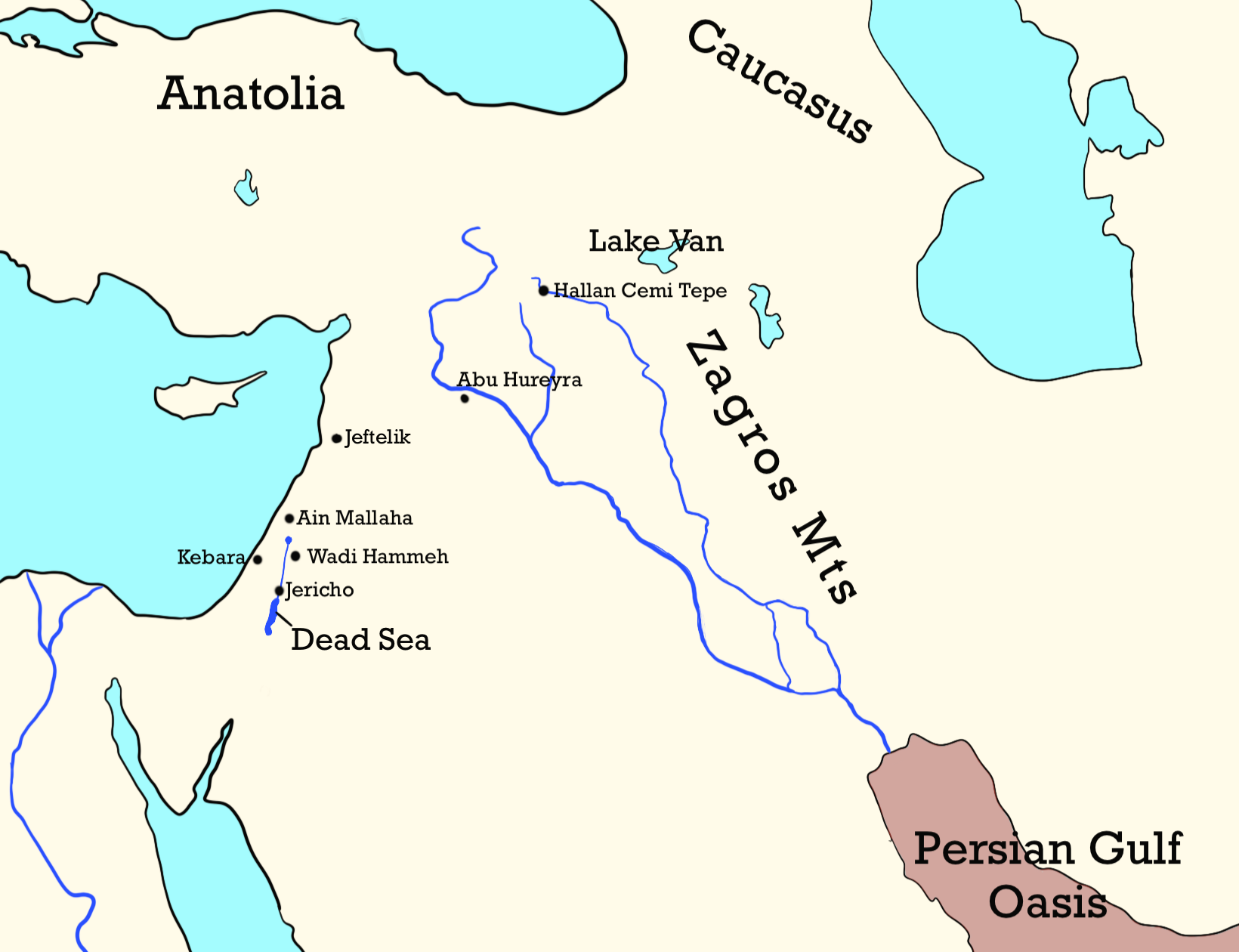
Figure 11.18 Map of select Early Natufian village sites. (Figure Credit 11.18: Drawing by Author)
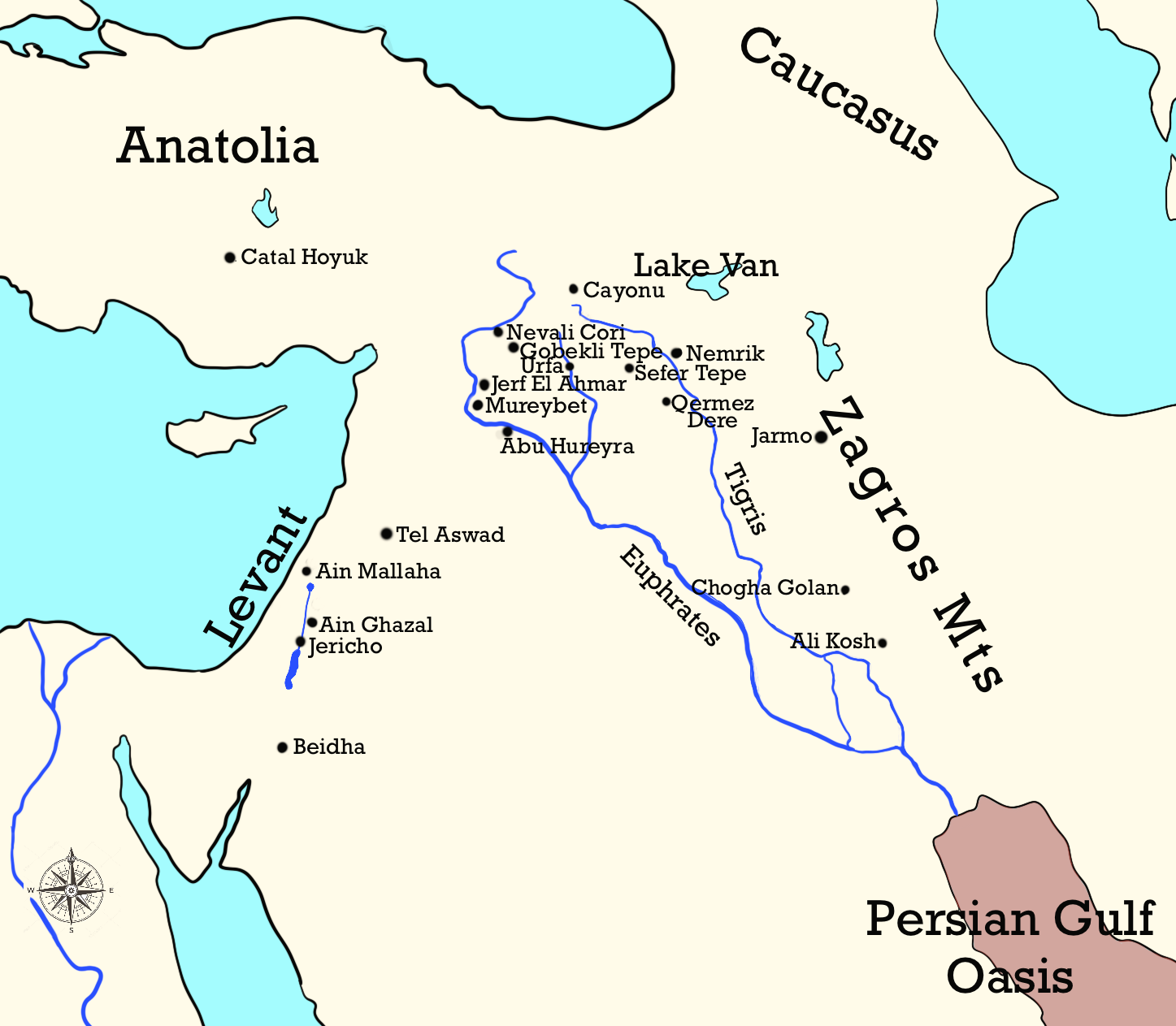
Figure 11.22 Map of select Late Natufian sites c. 9,500 YA. (Figure Credit 11.22: Drawing by Author)
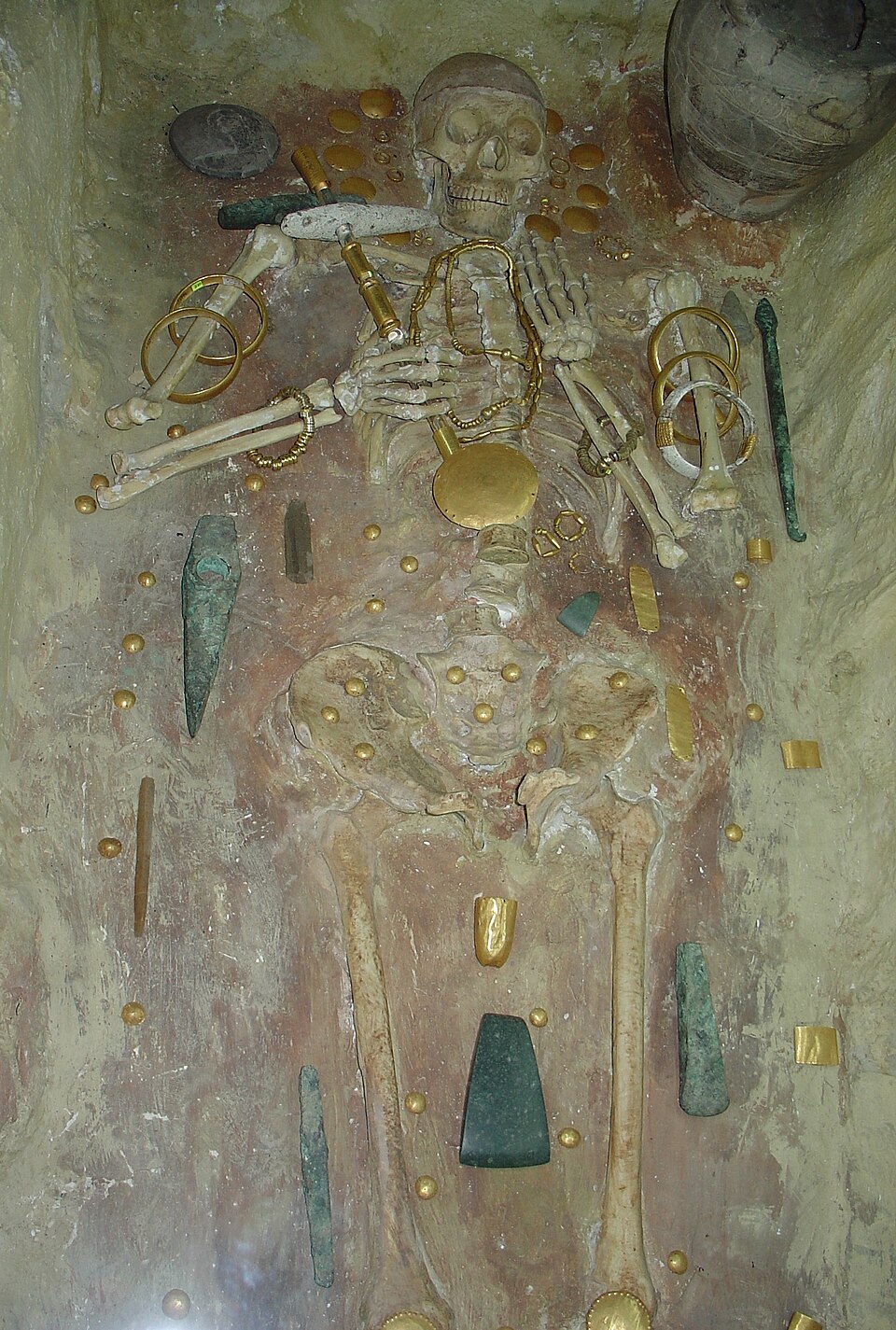
Figure 11.48 A Danube Civilization ornate burial 6,500 YA of an adult male of status containing red ocher, ceramic grave goods, seashells from the distant Aegean, axe heads and implements of copper, and gold jewelry—including a golden penis shroud. (Figure Credit 11.48: Yelkrokoyade under CC-BY-SA 3.0 Unported)
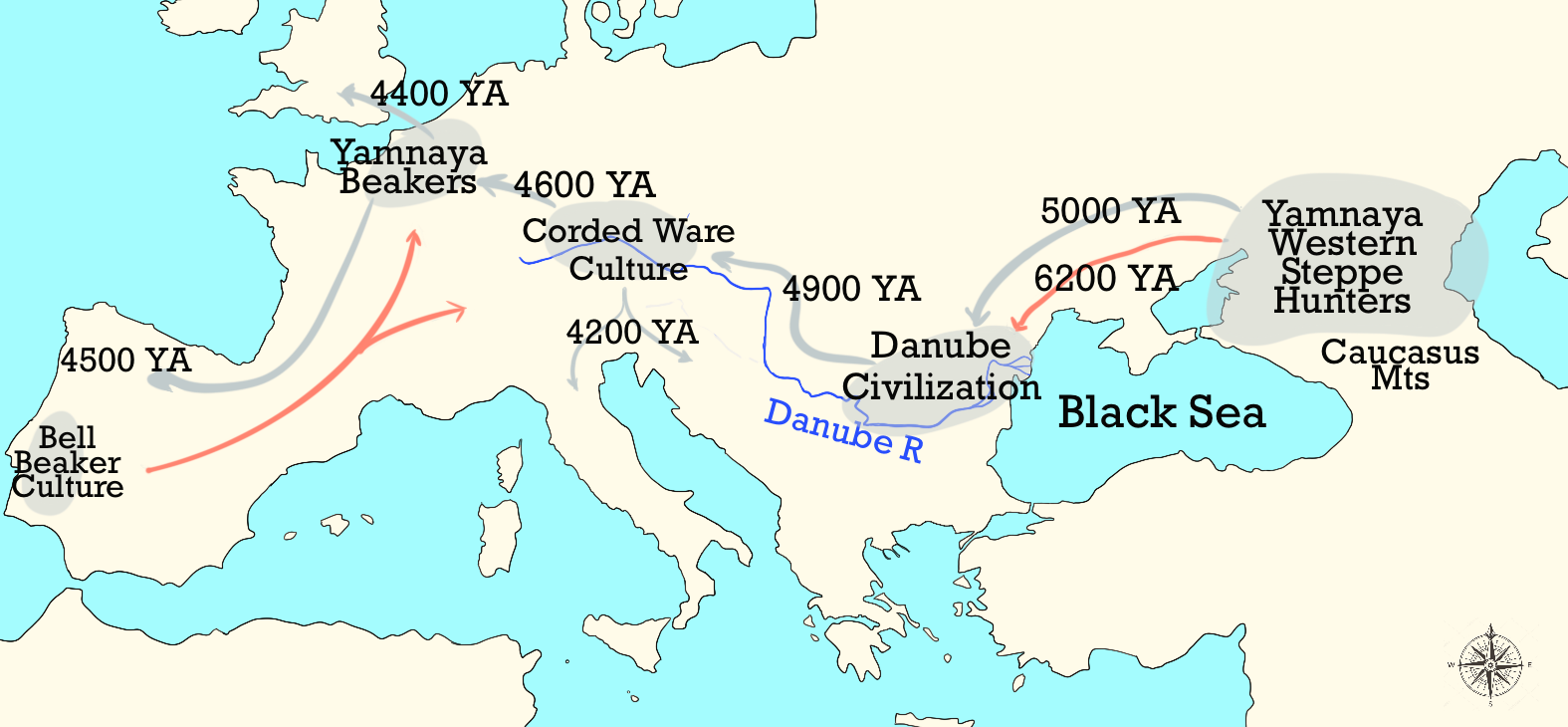
Figure 11.52 The Yamnaya 5th Wave European Expansion across the Danube River corridor into Western Europe, culminating in the invasion of Britain. (Figure Credit 11.52: Drawing by Author)
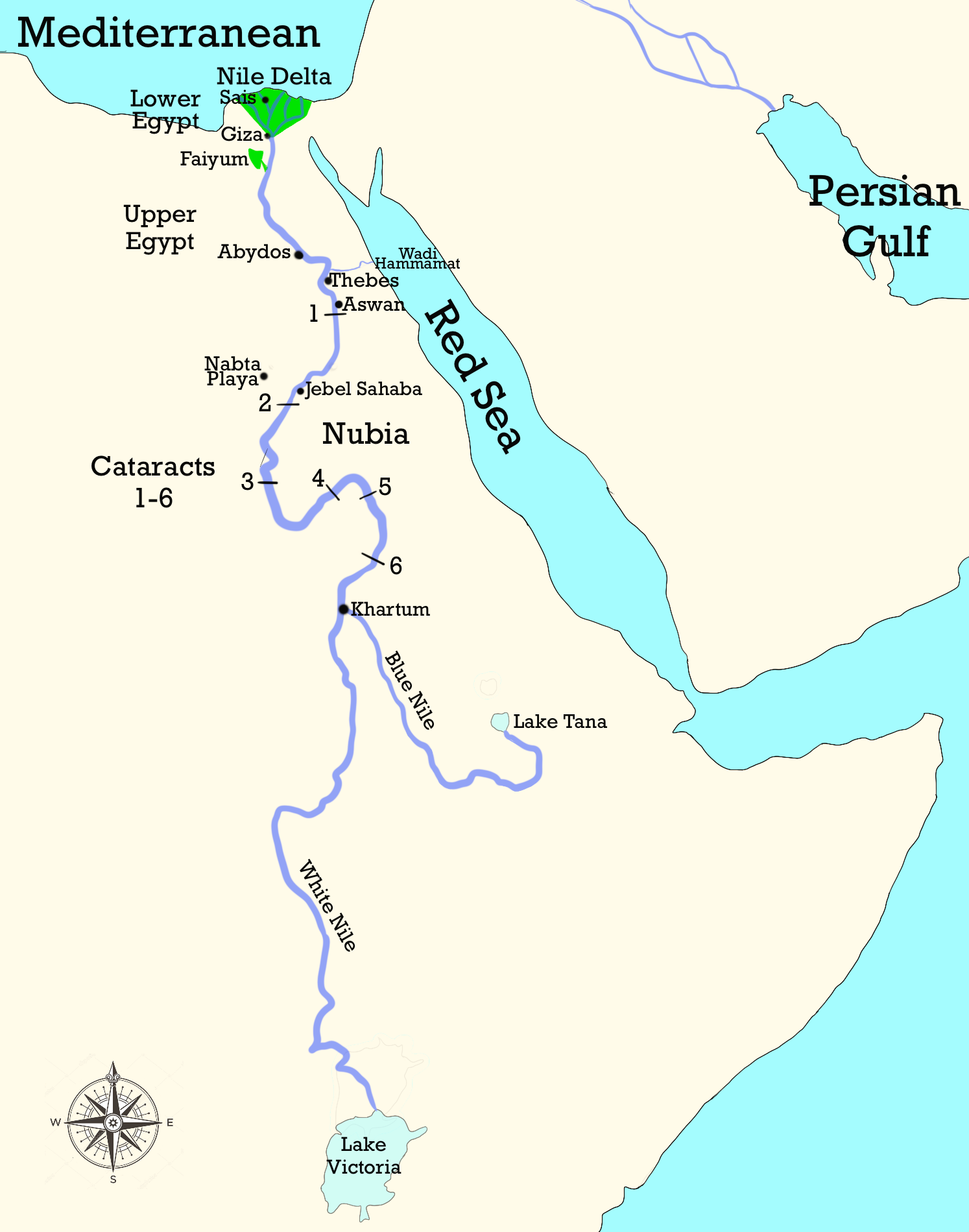
Figure 13.1 Map of the Nile River showing its two major tributaries, and the locations of its six cataracts or waterfalls. (Figure Credit 13.1: Drawing by Author)
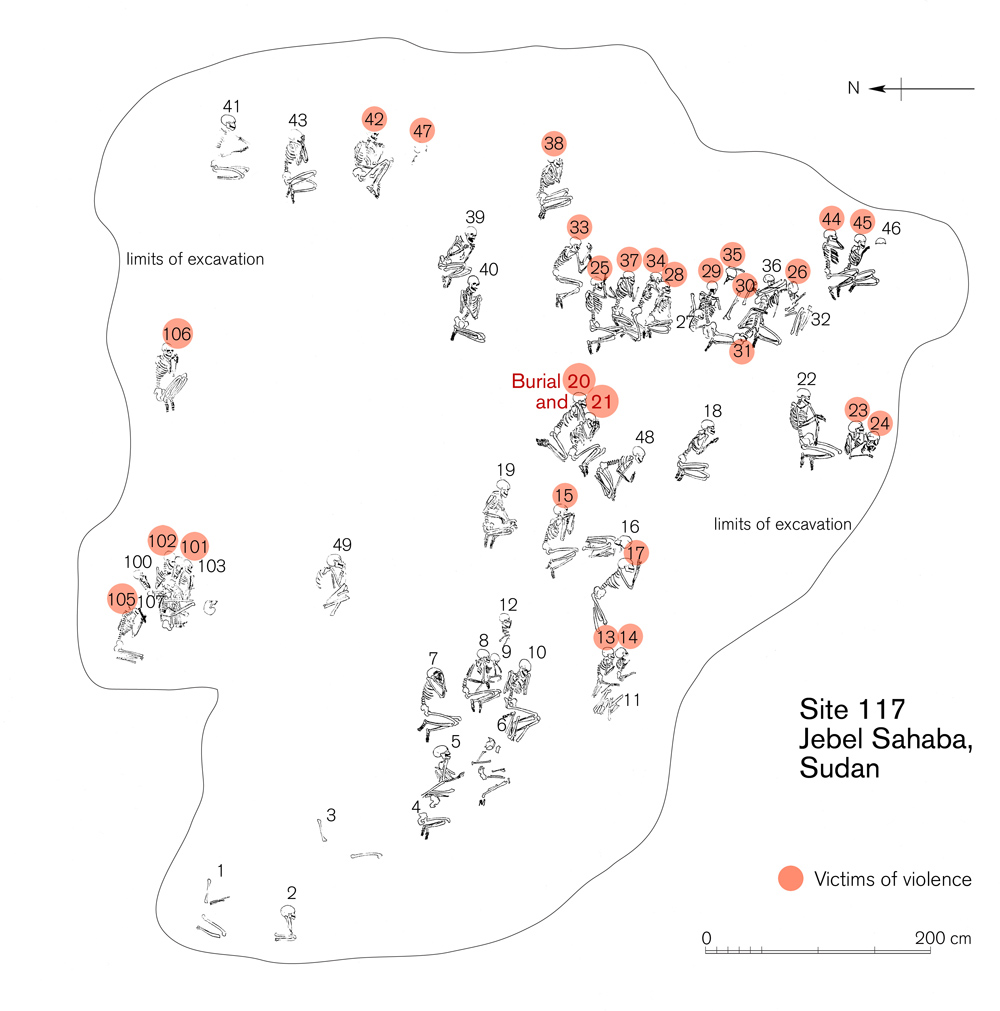
Figure 13.5 Map of cemetery Site 117 at Jebel Sahaba. The red dots indicate individuals showing skeletal evidence of weapons trauma and a violent death. (Figure Credit 13.5: Fred Wendorf Archive, British Museum, Public Domain)
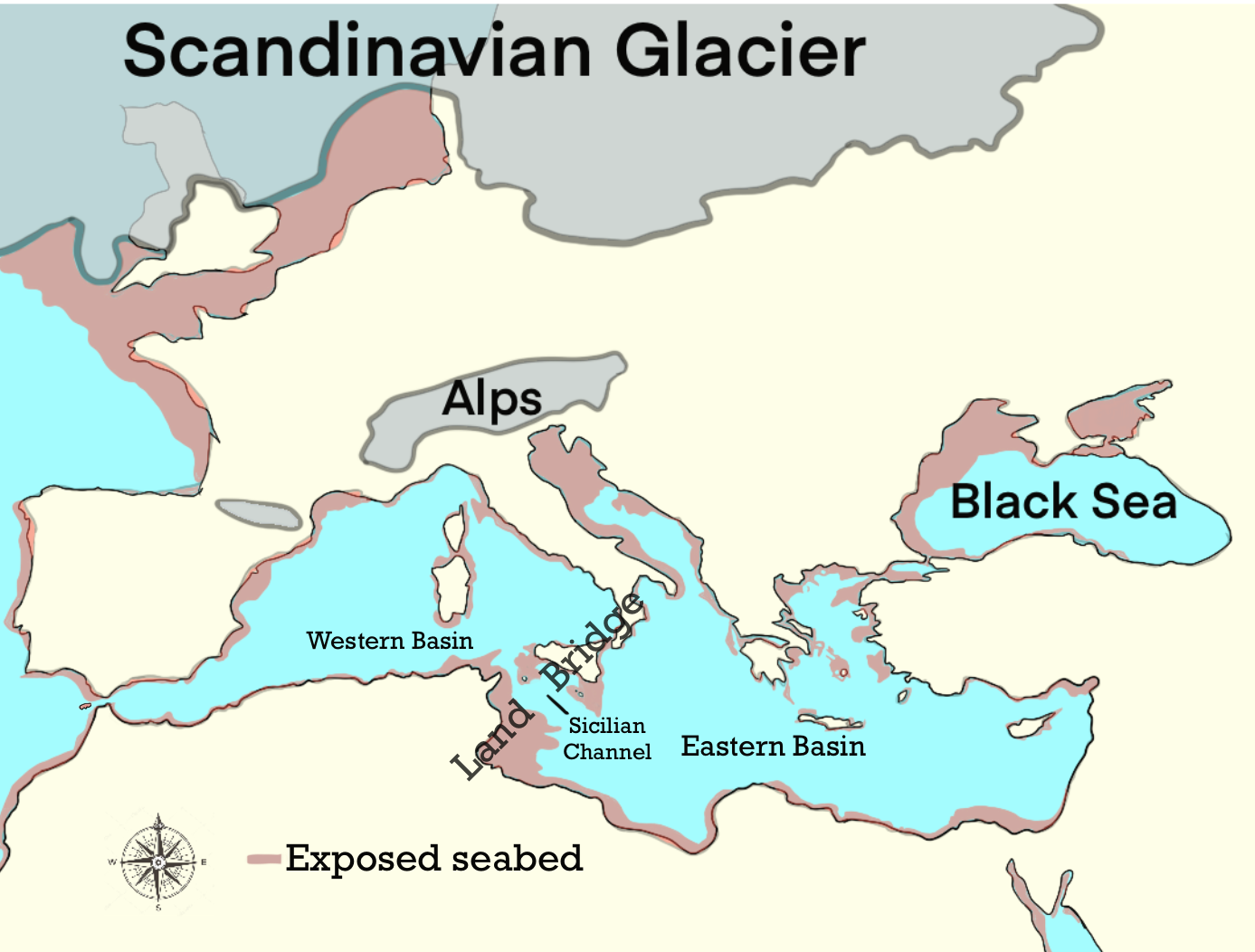
Figure 14.1 Lowstand sea level in the Mediterranean Sea during Last Glacial Maximum 22,000 to 17,000 YA. An incomplete Italo-Tunisian land bridge divided the Mediterranean into Eastern and Western basins, joined by the narrow Sicilian Channel. (Figure Credit 14.1: Drawing by Author)
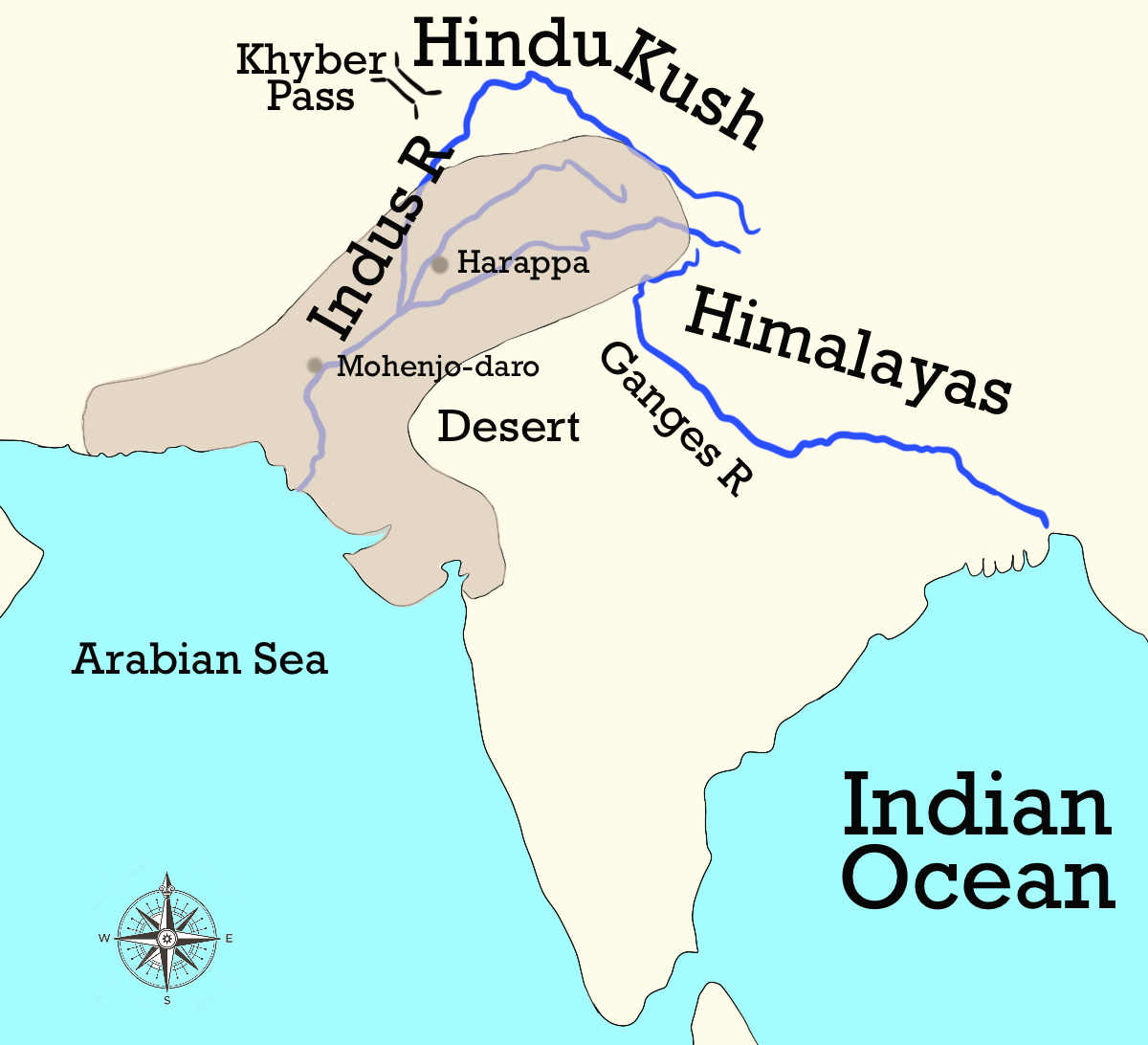
Figure 15.1 Indus Valley Civilization (shaded) at its greatest extent during its golden age c. 4,600 to 3,900 YA, showing major urban centers. (Figure Credit 15.1: Drawing by Author)
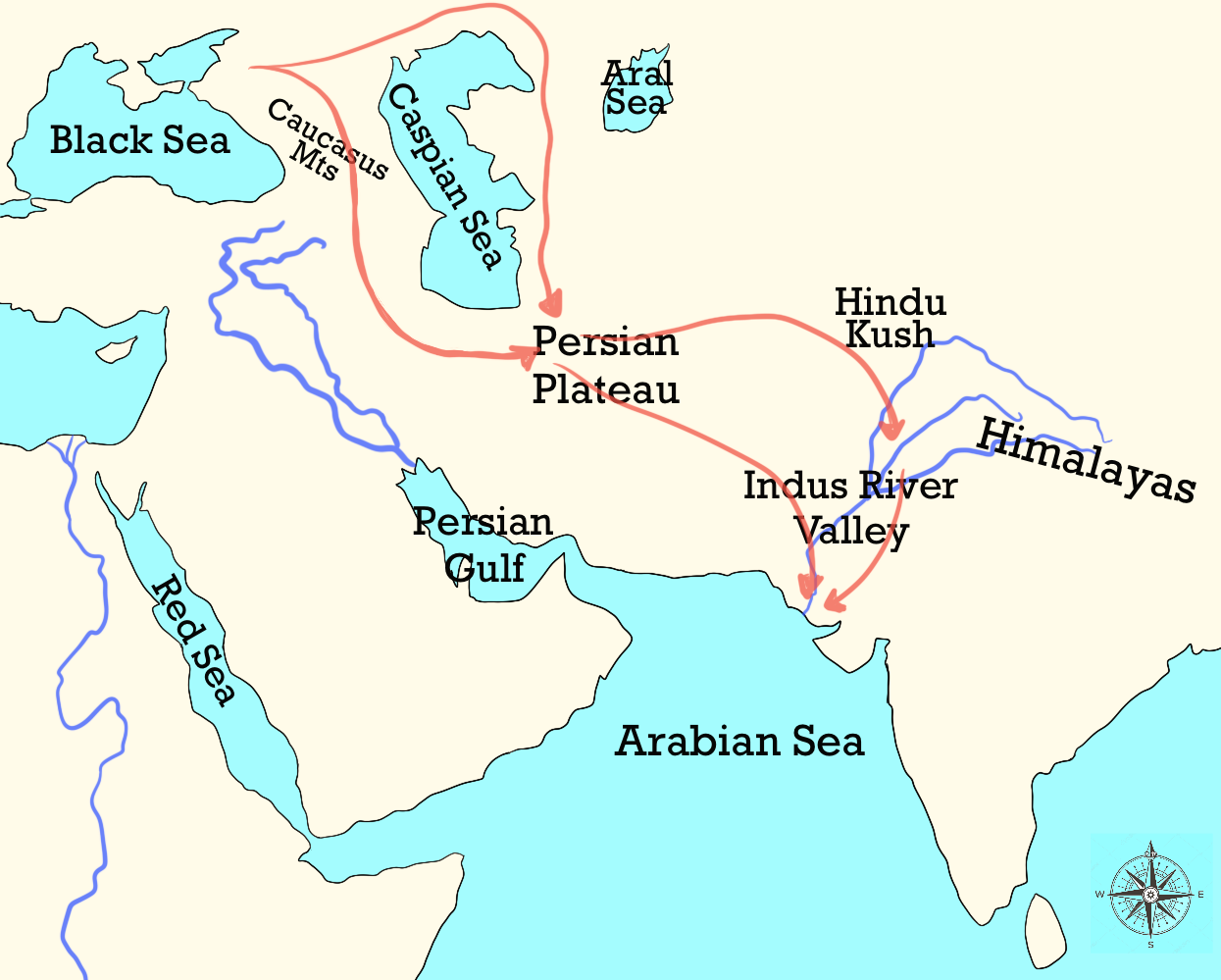
Figure 15.4 Proposed Aryan migration routes (in red) c. 3,800 to 3,700 YA. Successive waves moved south along different corridors encircling the Caspian Sea, converging on the Persian Plateau, and ultimately entered the Indus Valley. (Figure Credit 15.4: Drawing by Author)
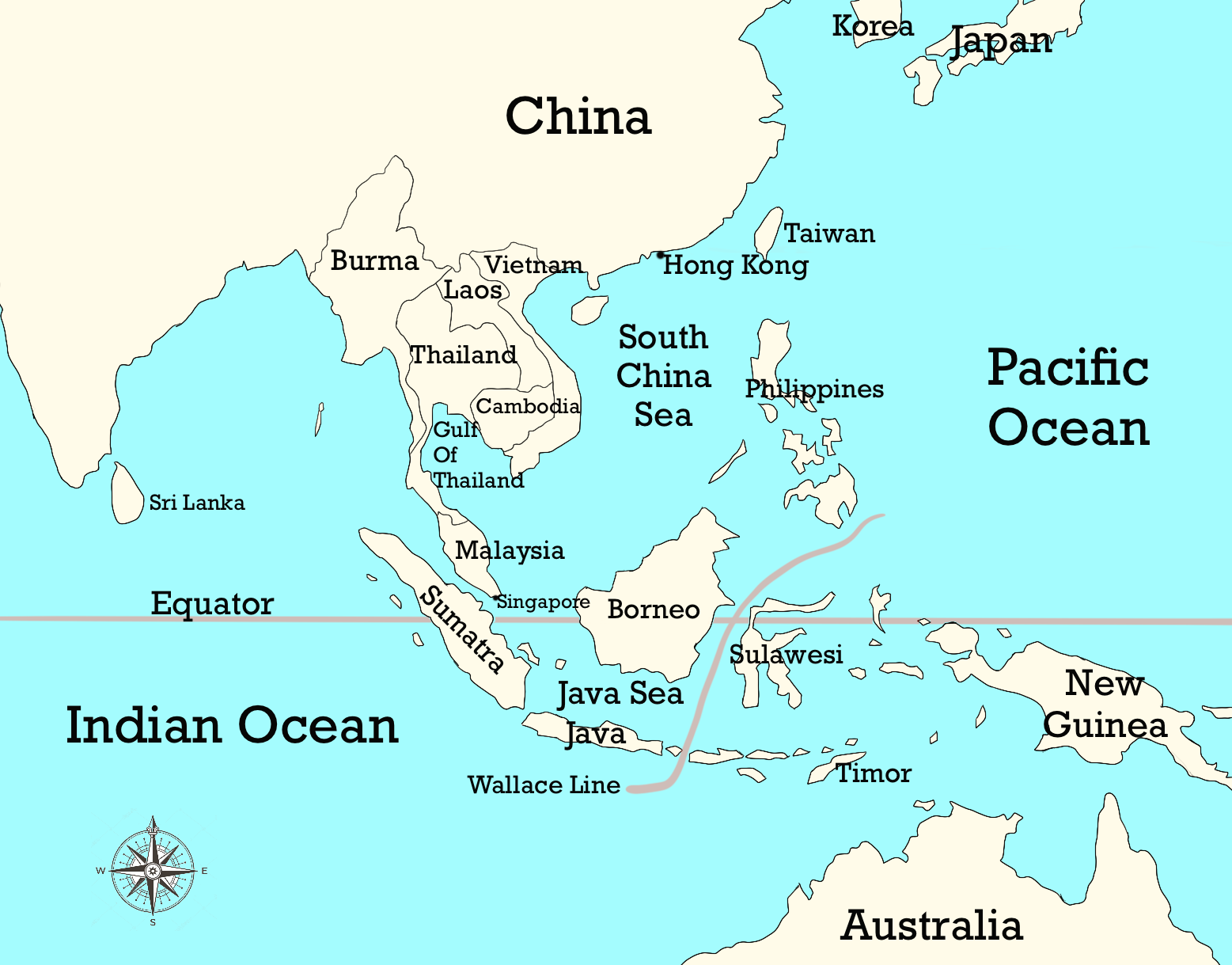
Figure 16.1 Modern day map of SouthEast Asia. Compare to Fig 16.2. (Figure Credit 16.1: Drawing by Author)
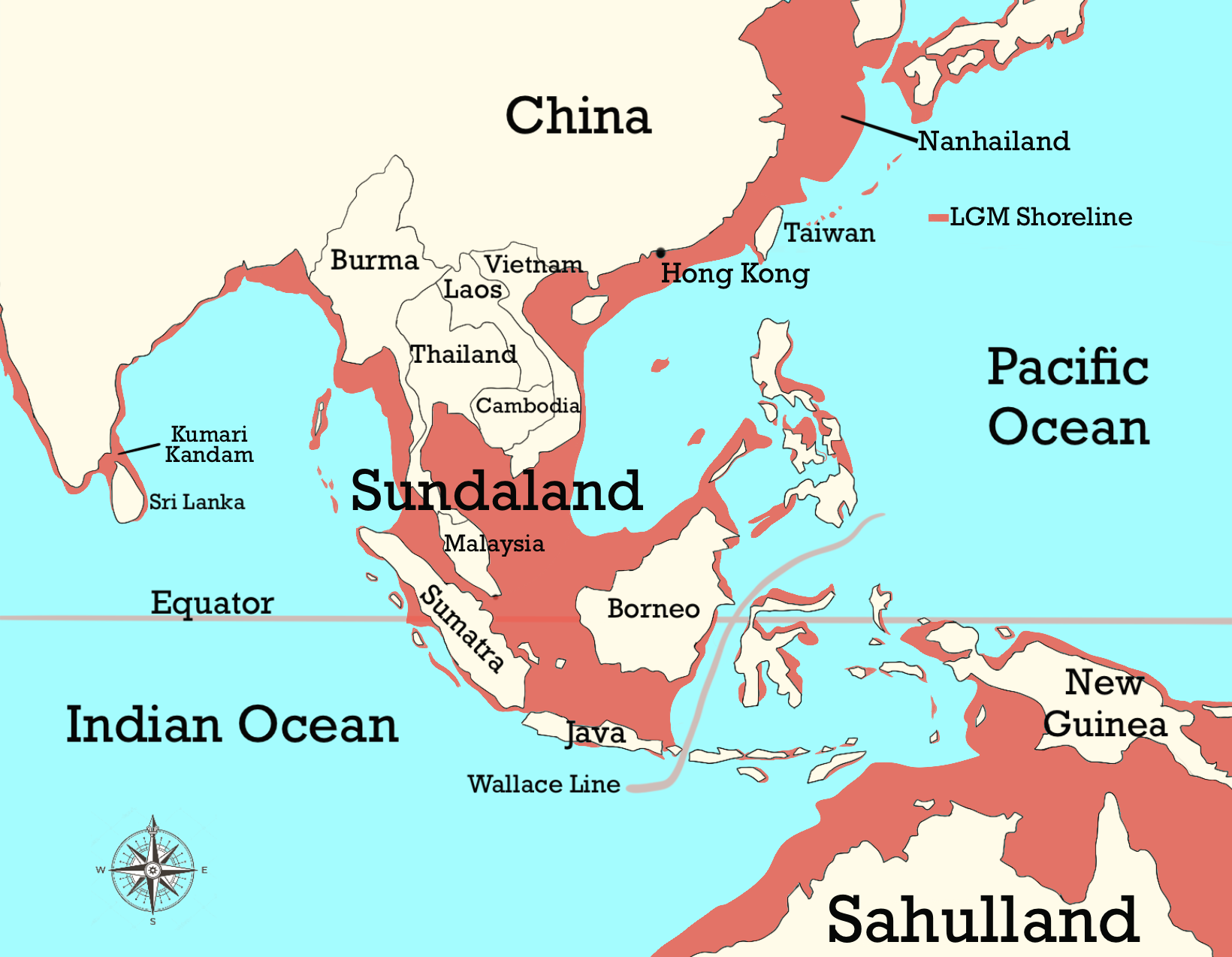
Figure 16.2 The Subcontinent of Sundaland during the hight of the Last Glacial Maximum 22,000 to 17,000 YA when global sea levels had fallen by up to 500 feet. (Figure Credit 16.2: Drawing by Author)
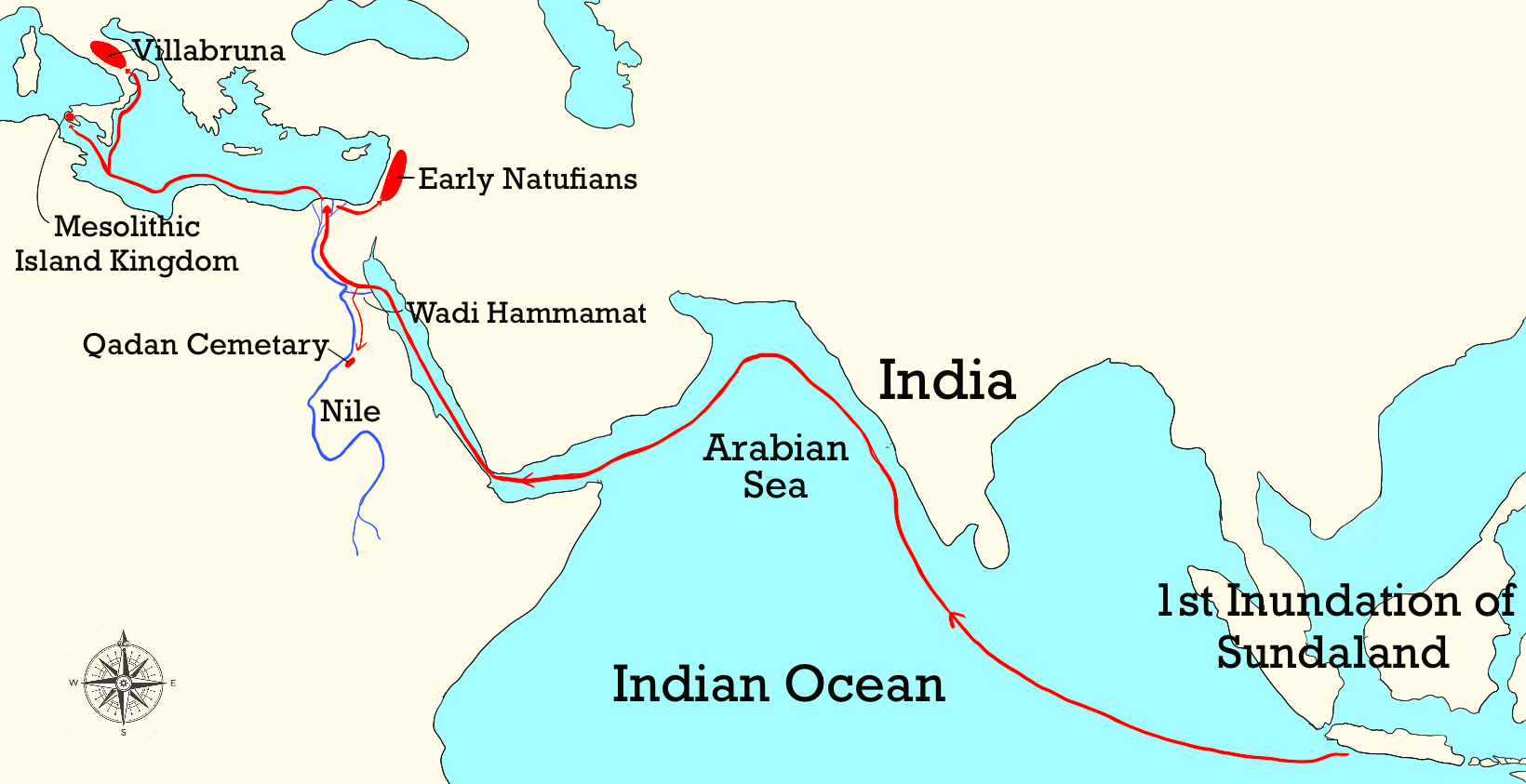
Figure 16.4 Map of forced migrations westward from Sundaland in the wake of its initial inundation by Meltwater Pulse 1A, c. 14,000 YA. These flood survivors constituted the Mesolithic ‘ghost’ population of the 3rd Wave European migration. (Figure Credit 16.4: Drawing by Author)
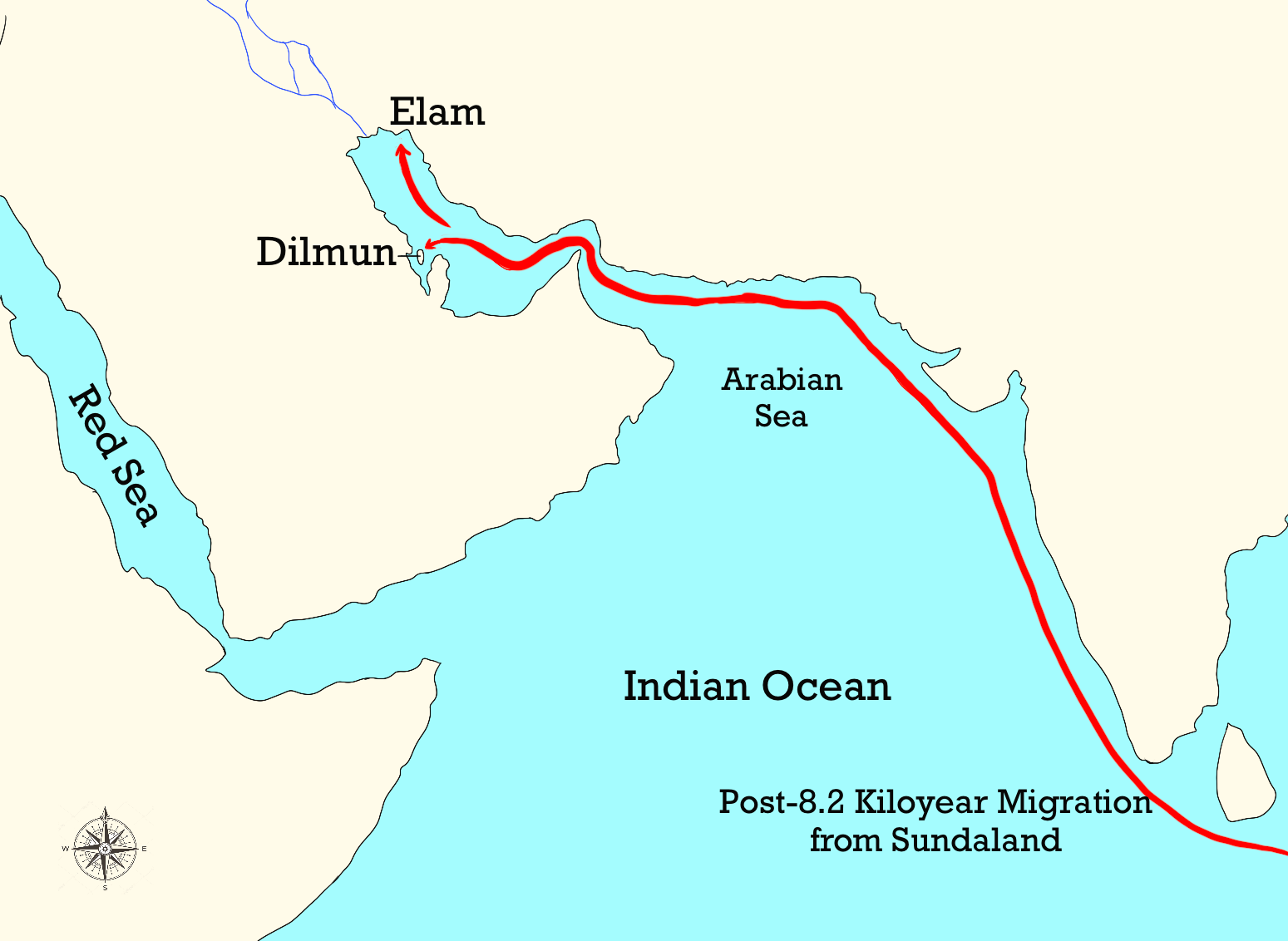
Figure 16.17 Proposed path of migration in the wake of the 8.2 Kiloyear Event by survivors from flood-ravaged Island SouthEast Asia (Java). These maritime migrants sailed to the newly flooded Persian Gulf and established Neolithic settlements on the western shore (at Dilmun), and the eastern shore (at Elam). (Figure Credit 16.17: Drawing by Author)
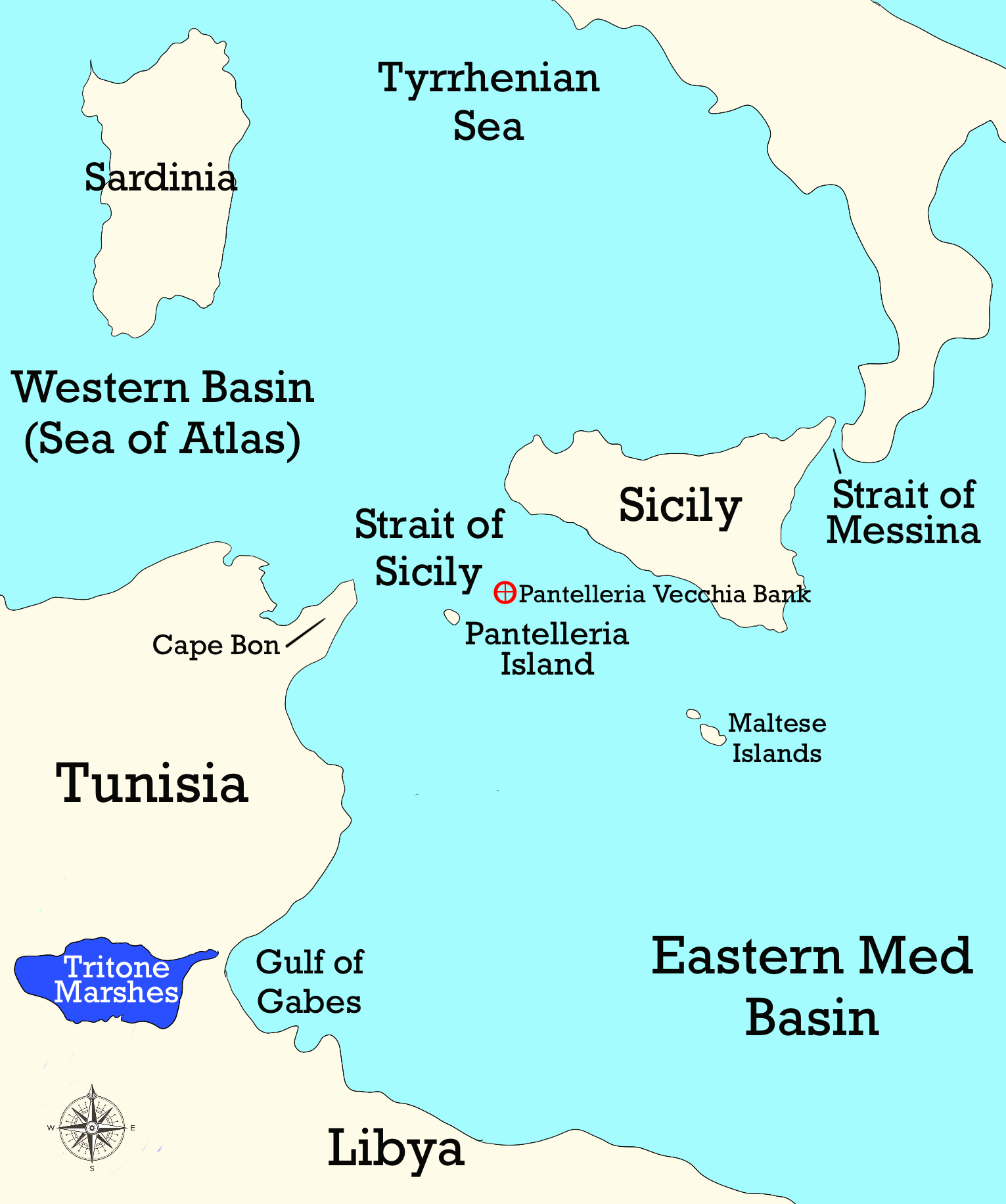
Figure 17.6 The Strait of Sicily (Sicilian Channel) divides the western Mediterranean basin (Sea of Atlas) from the eastern Mediterranean basin. Note the Island of Pantelleria and the submerged Pantelleria Vecchia Bank in the western part of the strait. The Tritone Marshes—remnants of the ancient inland mega-lake called Lake Tritonis—lie close to the Gulf of Gabes. (Figure Credit 17.6: Drawing by Author)
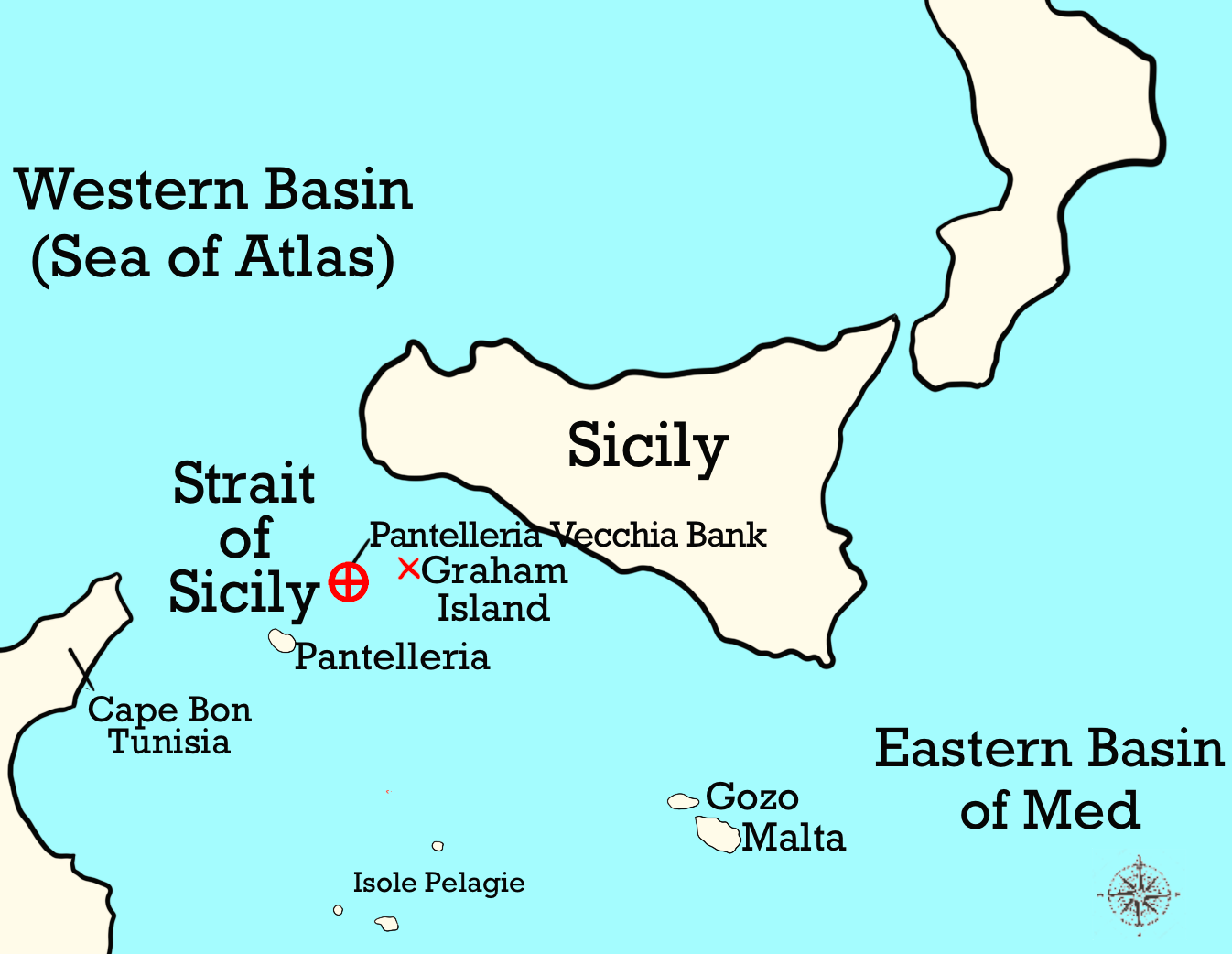
Figure 17.7 Location of the ephemeral Graham Island in the Strait of Sicily. Also note the location of the submerged Pantelleria Vecchia Bank. (Figure Credit 17.7: Drawing by Author)
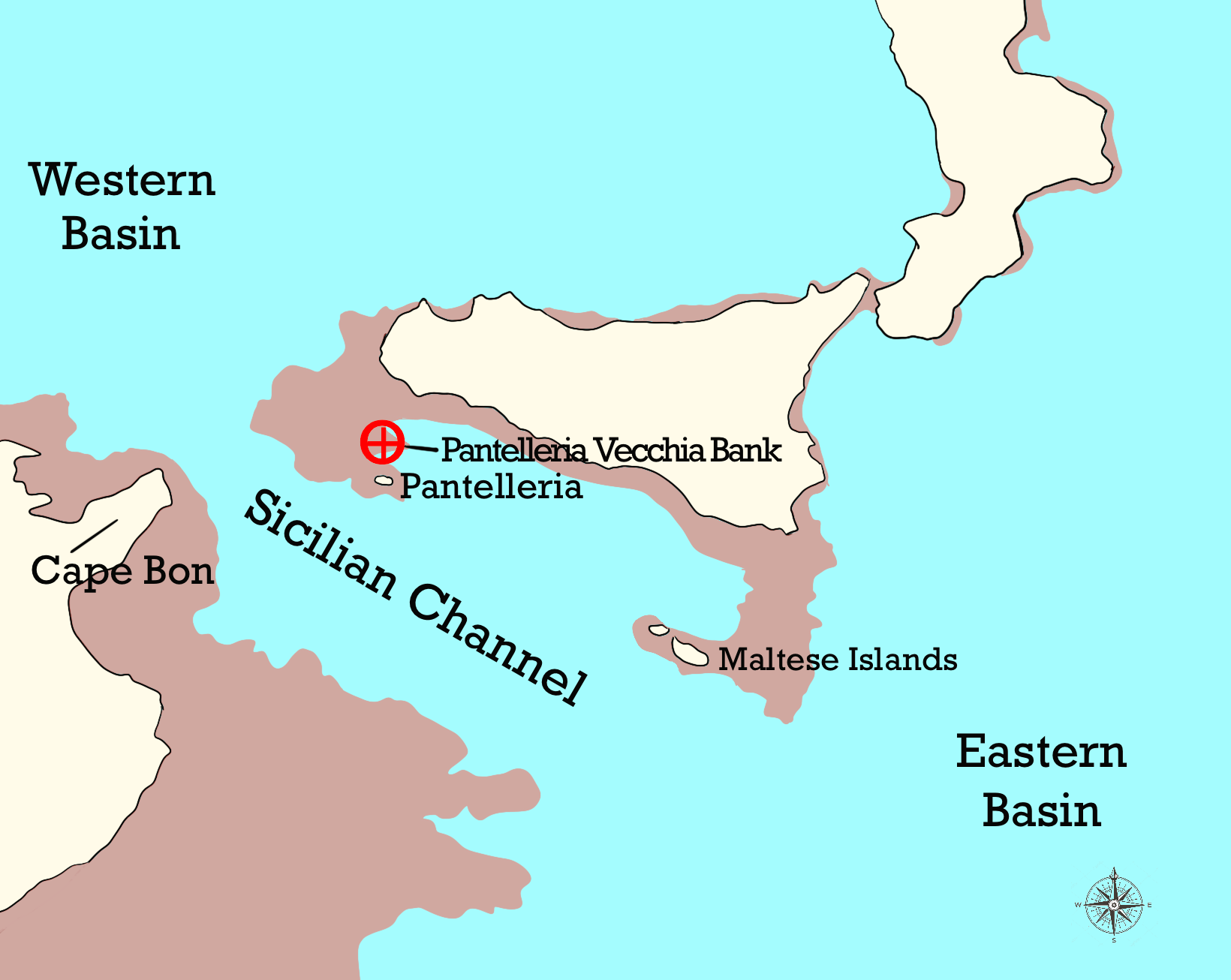
Figure 17.8 Detail of the incomplete Italo-Tunisian Land Bridge at the glacial low-stand. Note that Sicily—fused to the Italian peninsula—took on a crablike contour, with two ‘claw’ extensions: one enveloped the Maltese Islands to the southeast, and the other, Pantelleria to the southwest. The Tunisian coastline at the Cape Bon peninsula jutted northward toward Sicily, reducing the Strait of Sicily to a much narrower Sicilian Channel connecting the western basin (Sea of Atlas) to the eastern basin of the divided Mediterranean. (Figure Credit 17.8: Drawing by Author)
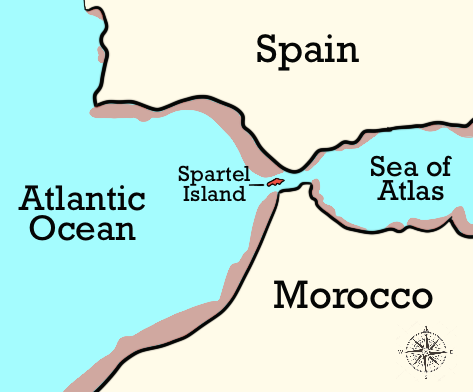
Figure 17.9 Spartel Island just west of the Strait of Gibraltar was swallowed by MWP 1B around 11,500 YA. The Island of Atlantis in the Strait of Sicily was likewise drowned at the same time. (sea levels reflect the lowstand of the Last Glacial Maximum (see Fig 14.1) (Figure Credit 17.9: Drawing by Author)
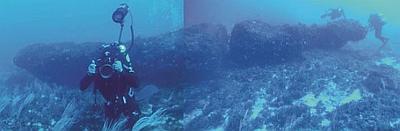
Figure 17.10 The Pantelleria Vecchia Monolith discovered submerged in 125 feet of water on the Pantelleria Vecchia Bank, a former island in the Sicilian Channel. At nearly 40 feet long and weighing 15 tons, the man-made monolith has cracked in half and has three holes bored through it. (Figure Credit 17.10: Emanuel Lodolo, National Institute of Oceanography and Experimental Geophysics (OGS), Public Domain)